Screen Addiction in Kids: 9 Signs and How to Break the Loop (2026)
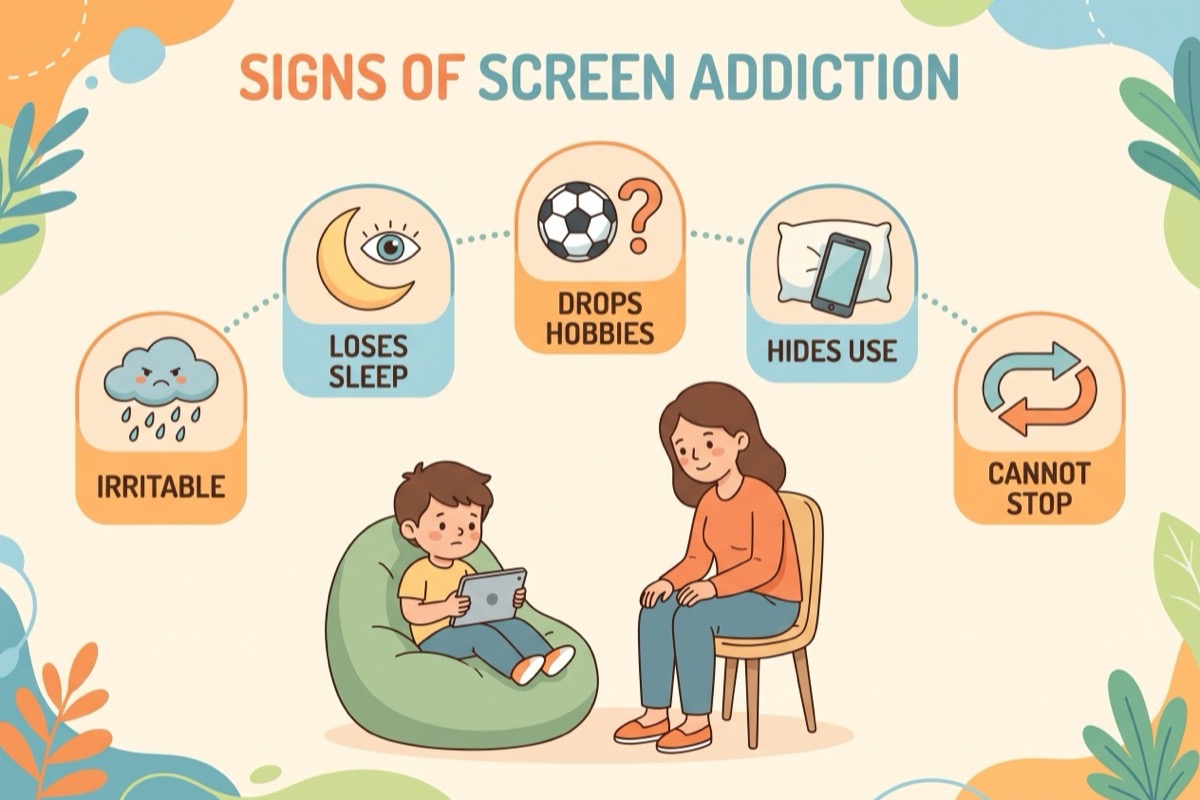
The tablet goes off, the meltdown starts, and a small voice asks whether this is still normal or whether it is screen addiction. Short answer: "screen addiction" is not an official diagnosis, but problematic screen use is real. The thing to watch is not the number of hours. It is whether your child can stop, and what the screen is crowding out.
Below: what the diagnoses actually say, the nine signs worth watching, why screens hook kids so well, and the ADHD connection. Then a four-week plan to ease off without hiding the phone in the freezer. If you are still at the "how much is okay" stage, start with our guide to recommended screen time by age. This one is for when the hours are no longer the real problem.
Is Screen Addiction a Real Diagnosis? What the Research Says
Short version: not under that name. Even Addiction Center, a site devoted to addiction treatment, states that the DSM-5 "does not specifically refer to a behavioral addiction called 'screen addiction.'" Two narrower labels do exist, and both are about gaming.
- Internet Gaming Disorder (DSM-5-TR). The American Psychiatric Association lists it in the section for conditions needing further research, not as a fully recognized disorder. It shares that section with caffeine use disorder, which tells you how cautious the manual is being. The proposed criteria list nine symptoms; a diagnosis under this framework would require five or more within a year.
- Gaming disorder (ICD-11, code 6C51). This one is official. The World Health Organization added it to the section on addictive disorders in 2018, and ICD-11 took effect on 1 January 2022. It means impaired control over gaming, gaming taking increasing priority over other activities, and continuing despite negative consequences. The pattern normally lasts at least 12 months and is severe enough to significantly impair family, social or school life.
That is the whole official list. Neither manual recognizes "social media addiction" or general "internet addiction." Researchers borrow the gaming criteria to study problematic social media use, but no separate diagnosis exists. The Children and Screens family guide agrees: as of late 2023, only gambling disorder and gaming disorder had official clinical recognition among "digital addictions."
How common is the official version? A 2017 estimate cited by the APA put Internet Gaming Disorder at 0.3% to 1.0% of the general population, though a 2022 study found notably higher rates. WHO says gaming disorder "affects only a small proportion of people who engage in digital- or video-gaming activities." For problem screen use in general, estimates vary widely with the questionnaire used, and there is no single official figure.
The American Academy of Pediatrics uses a different phrase, "problematic media use," and calls it "a problem that can be solved with the right support." It avoids the addiction framing on purpose. We say "screen addiction" here because that is what parents type into a search box at 11 p.m.
| The term | Official status | What it means for your family |
|---|---|---|
| Screen addiction | Not a diagnostic term in the DSM or the ICD | An everyday phrase for a real worry |
| Problematic media use | The AAP's term, checked with validated questionnaires | A problem that can be solved with the right support |
| Internet Gaming Disorder | DSM-5-TR, research section only | Nine proposed symptoms; five or more within a year |
| Gaming disorder (6C51) | Official WHO diagnosis, in effect since 2022 | Impaired control, rising priority, continuing despite harm |
| Social media or internet addiction | No official diagnosis | The concern is real; the label is not official |
Hours Are Not the Whole Story. The Pattern Is.
If screen addiction were measured in hours, plenty of American teenagers would qualify. The 2021 Common Sense census surveyed 1,306 US kids aged 8 to 18. Tweens averaged 5 hours 33 minutes of entertainment screen use a day and teens 8 hours 39 minutes, both up 17% from 2019. Those are still the latest tween and teen figures from that census.
A 2025 study in JAMA asked a better question. It followed 4,285 children from the NIH-funded Adolescent Brain Cognitive Development cohort for four years, starting at an average age of 10. Besides counting hours, it tracked addictive use: loss of control, using screens to escape problems, and similar symptoms.
Two findings matter. Total screen time at the start was not associated with worse mental health four years later. The addictive pattern was. Kids whose addictive social media use kept increasing had roughly twice the risk of suicidal behaviors by year four compared with kids on a low path (adjusted risk ratio 2.14). High addictive phone use carried a similar ratio (2.17), high addictive gaming a smaller one (1.54).
That is an association across thousands of children, not proof about any one child. It does change where to look. NewYork-Presbyterian says it plainly: how a child engages with screens matters more than total time.
Oddly, this is good news. You cannot argue a teenager down from eight hours in a week. You can notice whether they are able to stop, whether screens are their only way to calm down, and whether the rest of life is shrinking.
9 Signs of Screen Addiction in Kids
These follow the nine symptoms the DSM-5-TR proposes for Internet Gaming Disorder, translated into what you would see at home. Warning signs from the AAP and NewYork-Presbyterian fill in details. Researchers adapt the same criteria to study social media use, so the list is a useful guide beyond gaming.
- It is all they think about. Preoccupation. The game or the feed keeps running in their head through dinner, the car ride and homework.
- Switching off starts a 30-minute battle. Some grumbling is normal. Dr. Andrea Beth Temkin-Yu at NewYork-Presbyterian describes the warning version as extreme dysregulation when a child is blocked from a screen: "a 30-minute battle" rather than typical mild frustration. That is withdrawal in real life.
- The amount that used to be enough no longer is. Tolerance. The stopping point keeps moving, and yesterday's treat becomes today's minimum.
- They try to cut back and cannot. Often the kid agrees the limit is fair and still blows through it, which is exactly why this one is telling.
- Hobbies and friends quietly drop away. The AAP flags withdrawing from in-person friendships; NewYork-Presbyterian flags dropping previously enjoyed hobbies.
- They keep going even when it costs them. Declining grades appear on both the AAP and NewYork-Presbyterian lists. Late homework, a slipping grade, a lost privilege, and the screen still wins.
- They hide how much they use. Minutes get rounded down, and use drifts to times and places you will not see.
- Screens are their main way to calm down. The AAP names "using technology and digital media as the primary way to calm emotions" as a warning sign. The screen has stopped being fun and started being a coping tool.
- Something important is at risk. The DSM wording is jeopardizing a job or relationship. For a kid, that means standing at school, a place on a team, or a friendship that matters.
How to read the list: the DSM research framework asks for five or more within a year. WHO looks for a pattern that has usually lasted at least 12 months. One sign in a rough week is a kid being a kid. Several signs that stick around for months are a reason to act, starting with the plan below.
Why Screens Hook Kids: The Slot-Machine Loop
None of this means your kid lacks willpower. Notifications, likes and feeds run on the same reward schedule that makes slot machines habit-forming. Behavioral psychologists call it a variable-ratio schedule: the reward, a new like or message or post, arrives unpredictably. So the brain's dopamine system fires more in anticipation of checking than when the reward arrives. Behavioral psychology describes this kind of reinforcement as "extremely resistant to extinction." That is why the loop is hard to quit, for adults too.
Kids get a tougher deal. Children and Screens notes that adolescents are especially vulnerable because the prefrontal cortex, the brain's impulse-control "brakes," is not yet fully developed. That is a loop that rewards checking, running on a brain whose brakes are still being installed. Expecting a 12-year-old to out-willpower it alone is like expecting them to out-negotiate a casino. Children and Screens recommends rebalancing high-dopamine activities (instant gratification) with low-dopamine ones (delayed gratification), and the plan below leans on that idea.
Teenage Screen Addiction: What Changes in the Teen Years
Teenage screen addiction looks different from a 6-year-old's tablet meltdown. The platforms change, the hours climb, and the social side starts to carry real weight.
- Social media is where the diagnosis gap sits. Much of the worry about teens centers on feeds and group chats, and there is no official diagnosis for social media addiction. That does not make the problem imaginary. It means you judge by the nine signs, not by a label.
- The direction of travel matters. In the JAMA study, 31.3% of kids were on an increasing addictive social media path and 9.6% started high and peaked. Both groups carried more risk than kids whose symptoms stayed low. The rising group is the one you can catch early.
- The brakes are still under construction. A still-developing prefrontal cortex helps explain why a limit your 15-year-old sincerely agrees to on Sunday can collapse by Tuesday.
For teens, the phone is also where their social life happens, so confiscation can feel like exile. The AAP favors self-monitoring approaches over a one-size cutoff, and with a 15-year-old, their own tracking has to do the work when you are not in the room. If the phone has not arrived yet, our guide on what age a child should get a phone walks through readiness.
ADHD and Screen Addiction: A Two-Way Street
If your child has ADHD and screens seem harder for them to put down, at least one child psychiatrist sees the same pattern. Dr. Clifford Sussman, quoted by Children and Screens, says about 80% of the children he sees with screen use disorders also have ADHD. That is one clinician's estimate from his practice, not a population statistic. He describes the link as running both ways. Screen time can worsen ADHD-linked sleep and attention problems. ADHD's weaker impulse control, his "bad brakes," makes kids more likely to seek the instant gratification screens deliver.
Can screens cause ADHD? A 2024 Mendelian randomization study, a genetic design meant to test which way cause runs, found evidence that phone use and TV watching may raise childhood ADHD risk. It found no significant effect for computer use and no reverse effect of ADHD on screen time. The result held in only two of five statistical methods, and the authors wrote that it "warrants further investigation." Possible, not proven.
At home, weaker brakes mean the environment has to do more of the braking: fewer triggers in reach, visible stopping points, a routine that does not depend on memory. The AAP also recommends treating underlying conditions such as ADHD, anxiety, eating disorders or family conflict when problematic media use shows up alongside them.
How to Break Screen Addiction Without a Cold-Turkey War
Children and Screens recommends harm reduction: reduce use gradually and rebalance the day rather than removing screens overnight. In practice that comes down to six moves.
- Watch the pattern first. A week of noticing tells you which of the nine signs are real and which were one bad Tuesday. Older kids can track their own use alongside you.
- Set screen-free zones and times. The dinner table, bedrooms at night, the first stretch after school. Fixed rules take the daily negotiation off the table, literally in the first case.
- Shift limits in small steps. Trim a little, hold it until it feels normal, trim again. A small cut that holds beats a big cut that collapses on day three.
- Add low-dopamine activities. Reading, building, outdoor play, cooking, a sport. Without things that pay off slowly, the fastest reward in the room wins by default.
- Take your credit card off the account. Children and Screens suggests keeping in-game and in-app purchases off parents' cards and using capped gift cards if spending is allowed at all. Our Roblox parental controls guide covers the spending settings on one big platform.
- Use device settings as a backstop. iPhone parental controls can hold a limit when you are not in the room. They support the family agreement; they do not replace it.
What Does Not Work
- Cold turkey as the automatic answer. In a Q&A on cutting toddler screen time cold turkey or gradually, the AAP's Center of Excellence says research does not support a single "right" approach. If you do remove screens abruptly, expect an "extinction burst," a temporary spike in complaining and whining before it subsides, and stay consistent through it. Giving in at the peak teaches that the burst works.
- Counting hours and nothing else. The JAMA data point at the pattern, not the clock. A kid who watches two long movies on Saturday and stops without a fight is in a different place from one who cannot put a phone down for ten minutes.
- The "addict" label. The AAP frames problematic media use as solvable. Calling a child an addict mid-argument adds shame and not a single tool.
- One cutoff for every kid. The AAP favors cognitive-behavioral, self-monitoring approaches over a "cookie-cutter" cutoff. The same number can be generous for one child and impossible for another.
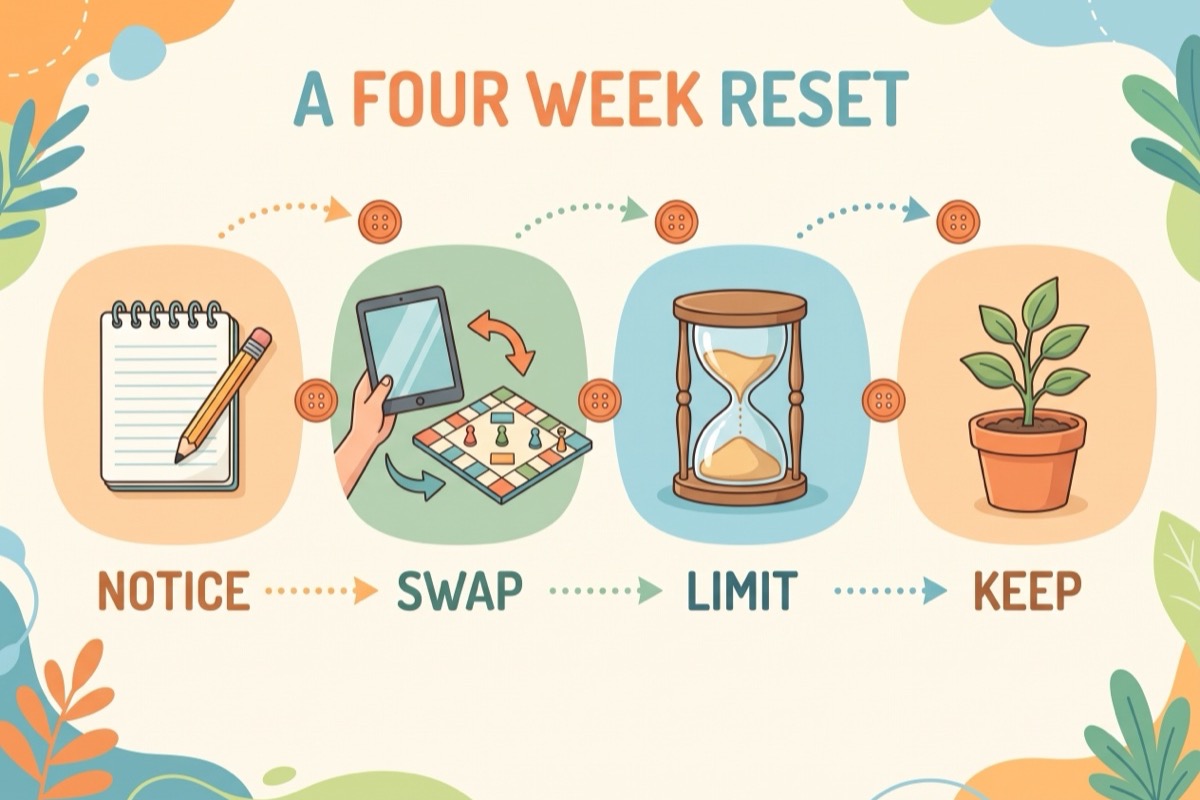
A Four-Week Plan to Ease Off Screens
This four-week structure is ours, built on the AAP and Children and Screens guidance above. It is not an official clinical protocol, so adjust it to your child.
| Week | Focus | What you do | What your kid does |
|---|---|---|---|
| Week 1 | Notice | Check the nine signs and note when and why screens come out. Change nothing yet. | If old enough, tracks their own use. |
| Week 2 | Zones and times | Pick one or two screen-free places or times and hold them daily. | Helps choose the zones and knows the rule before it starts. |
| Week 3 | Rebalance | Trim limits one small step. Add one low-dopamine activity on most days. | Picks the replacement activity and ticks it off on a visible checklist. |
| Week 4 | Agree and adjust | Review what worked, write the family rules down, move spending to capped gift cards. | Signs the rules and knows what happens when a limit is missed. |
If you went faster and hit an extinction burst, that is expected. Stay consistent, keep the replacement activities coming, and let the chart on the fridge be the bad guy. A replacement sticks better when it leads somewhere the child cares about: how to raise a motivated child without pressure.
When to Get Help
Bring in your pediatrician or a mental health professional when:
- Several of the nine signs have lasted for months and the plan above is not moving them.
- Grades are falling, in-person friendships are fading, or screens have become the main way your child calms down. All three are on the AAP's warning list.
- You suspect something underneath, such as ADHD, anxiety, an eating disorder or conflict at home.
- Your child talks about self-harm or not wanting to be here. Treat it as urgent and get professional help the same day. In the US, you can call or text 988 to reach the 988 Suicide & Crisis Lifeline.
There are validated tools for this conversation. The AAP's Center of Excellence recommends the PRIUSS (Problematic and Risky Internet Use Screening Scale) for ages 11 and up, in a brief 3-item and a full 18-item version. For children 11 and under, it recommends a parent-completed Problematic Media Use Measure. Ask your pediatrician for one by name.
Key Takeaways
- "Screen addiction" is not an official diagnosis. ICD-11 gaming disorder is the only official screen-related one; the DSM-5-TR keeps Internet Gaming Disorder in its research section.
- The pattern matters more than the hours. In a 2025 JAMA study of 4,285 kids, total screen time did not predict worse mental health; addictive-use patterns did.
- Watch for the nine signs, especially the 30-minute battle at switch-off, fading friendships, and screens as the main way to calm down.
- The hook is built in. Variable rewards plus a still-developing prefrontal cortex make stopping hard. That is how the loop works, not a character flaw.
- ADHD and problem screen use often show up together. One child psychiatrist describes a two-way link; screens causing ADHD is possible, not proven.
- Go gradual and add, not just subtract. Screen-free zones, small steps, slow-reward activities, and consistency through any extinction burst.
Frequently Asked Questions
Is screen addiction a real diagnosis?
Not under that name. Neither the DSM-5-TR nor the WHO's ICD-11 lists screen addiction, social media addiction or internet addiction. The one official screen-related diagnosis is gaming disorder in ICD-11 (code 6C51), in effect since January 2022. The DSM-5-TR keeps Internet Gaming Disorder in its research section. The AAP uses the term problematic media use instead.
What are the symptoms of screen addiction in kids?
The nine signs follow the DSM-5-TR's proposed gaming criteria. Look for preoccupation, extreme upset when screens go off, needing more over time, and failed attempts to cut back. Also watch for dropped hobbies and friends, continuing despite problems, hiding use, relying on screens to calm down, and putting school or relationships at risk. Several signs lasting months matter more than one bad week.
How many hours of screen time is too much?
Hours alone do not define the problem. A 2025 JAMA study of 4,285 children found that starting screen time was not associated with worse mental health four years later, while a pattern of addictive use was. Watch whether your child can stop and what screens are replacing.
Should I take screens away cold turkey?
The AAP says research does not support a single right approach, and Children and Screens recommends gradual reduction. If you do remove screens abruptly, expect an extinction burst, a temporary spike in difficult behavior, and stay consistent until it passes.
Is there a link between ADHD and screen addiction?
Yes, though the direction is not settled. Child psychiatrist Dr. Clifford Sussman estimates about 80% of the children he sees with screen use disorders also have ADHD, and describes the link as two-way. A 2024 genetic study found possible causal effects of phone and TV use on ADHD risk, but only in two of five methods.
When should I talk to a doctor about my child's screen use?
When several warning signs last for months, grades or in-person friendships decline, screens become the main way your child calms down, or you suspect ADHD or anxiety underneath. Any talk of self-harm is urgent. In the US, you can call or text 988 to reach the 988 Suicide & Crisis Lifeline. Pediatricians can use AAP-recommended screening tools such as the PRIUSS for ages 11 and up.
Related Reading
- Recommended Screen Time by Age: What the Guidelines Say (2026)
- Parental Controls on iPhone: A 15-Minute Setup for Kids (2026)
- What Age Should a Child Get a Phone? A Readiness Checklist (2026)
- Infant Screen Time: What Babies and Toddlers Really Need (2026)
- Social Media Age Limits: The Main Apps, Laws and Countries (2026)
- Smartphone Free Childhood: What Towns and Countries Actually Did (2026)
Turn your screen rules into a checklist the kids can see
Screen-free zones, the replacement activities, the switch-off time: put them on one daily chart on the fridge, so the rules do the reminding instead of you. Printable, free, no signup required.
Make a free screen rules chart
