What Age Should a Child Get a Phone? A Readiness Checklist (2026)
Somewhere around 8 or 9, the question shows up at dinner, usually with a list of classmates who already have one. So, what age should a child get a phone? The honest answer from pediatricians is that there is no single right age. Most US kids get a first smartphone around 11, but the better question is whether this particular kid is ready for this particular device.
That is less of a dodge than it sounds. A phone that calls and texts and a smartphone with a browser and an app store are two different decisions, and most families can make them years apart. Below: what the research actually says (including a large 2026 study most older articles miss), a readiness checklist, a staged path, and a four-week plan. If social media is the real worry, our guide to social media age limits covers every app.
What Age Should a Child Get a Phone? What the Research Says
Start with what is typical, because that is what your child is comparing against. The figures depend on who asked and when, so each one comes with its source.
- Around 11 for a first smartphone. The AAP's guidance on a first phone says most children currently get one around 11. Common Sense Media's 2023 "Constant Companion" report agrees: about half of US kids have a smartphone by 11, citing 2022 research.
- About 3 in 10 at ages 8 and 9. The Common Sense Media census of tweens and teens (2021) found 43% of 8- to 12-year-olds owned a smartphone, up from 24% in 2015. By age, about 3 in 10 of 8- and 9-year-olds owned a phone, about 7 in 10 of 12- and 13-year-olds, and about 9 in 10 at 14 and older.
- Nearly 1 in 4 by age 8. Common Sense Media's 2025 census of children up to age 8 found nearly 1 in 4 have their own cellphone by 8.
- Most under-13s still do not have one. In a 2025 survey the AAP cites, 75% of parents of children under 13 said their child did not have a smartphone yet.
If those numbers seem to disagree, they do. Different years, different samples, different definitions of "phone." The claim that "everyone in fifth grade has one" usually comes from a much smaller sample: one lunch table.
What pediatricians say
The American Academy of Pediatrics' parent site, HealthyChildren.org, declines to name an age. It tells parents to look at the child instead: responsibility, impulse control and judgment. For kids who need to reach you but are not ready for the full thing, it suggests a flip phone or a smartwatch as the in-between step.
The Child Mind Institute is firmer about smartphones: wait until at least 8th grade. It pairs that with a list of readiness factors, which the checklist below is built on.
The newest study: 12-year-olds and smartphones (2026)
In January 2026, a study in Pediatrics looked at 10,588 kids from the Adolescent Brain Cognitive Development (ABCD) Study. Twelve-year-olds who owned a smartphone had higher odds of depression (odds ratio 1.31), obesity (1.40) and insufficient sleep (1.62) than 12-year-olds who did not.
Two more findings speak directly to timing. Each year earlier a child got a smartphone was linked to slightly higher odds of obesity (1.09 per year) and insufficient sleep (1.08 per year). And kids who were phone-free at 12 but got one at 13 still had higher odds of clinical psychopathology (1.57) and insufficient sleep (1.50) than peers who stayed phone-free.
These are associations, not proof that phones cause depression. The team at Children's Hospital of Philadelphia frames it that way too. Lead researcher Dr. Barzilay asks caregivers to approach the decision "with care," and the hospital recommends setting family rules and phone-free times before a device changes hands, rather than relying on age alone.
One smaller counterpoint is worth knowing. A California study of 263 Latinx children, cited by the AAP, found an average first-phone age of 11.6. In that sample, getting a phone at that age was not tied to higher rates of sleep problems, school problems or depression symptoms. One community, a small group, but a reminder that the birthday alone does not decide the outcome.
What kids say, looking back
Teens and young adults are more cautious than you might expect. A survey of 765 of them, cited by the AAP, recommended a first phone between 12 and 13, tied to needing independence from parents. A survey of 469 young people in JMIR Pediatrics and Parenting found they got their first phone at 12.2 on average and would recommend 12.7. Parents lean later still. In a parent-opinion survey cited by Brown University Health, 45% picked 12 to 14 for a first smartphone, 28% picked 15 to 17, and 16% picked 9 to 11.
Who Recommends What, Side by Side
Here is every recommendation in one place. Notice how many of them treat a basic phone, a smartphone and social media as three separate decisions. A dash means no figure for that column.
| Source | Basic phone or watch | Smartphone | Social media |
|---|---|---|---|
| AAP (AAP.org and HealthyChildren.org) | Flip phone or smartwatch as an interim option | No single right age; judge responsibility, impulse control and judgment | At least 13, a line that comes from privacy law, not developmental research |
| Child Mind Institute | – | At least 8th grade, plus readiness factors | – |
| Wait Until 8th pledge | "A basic phone that just calls and texts" is allowed | Not until at least the end of 8th grade | – |
| Smartphone Free Childhood Parent Pact (UK) | – | Not until 14 | Not until 16 |
| Teens and young adults (765, cited by the AAP) | A first phone at 12 to 13 (type not specified) | – | |
| Parents (survey cited by Brown University Health) | – | 45% say 12–14, 28% say 15–17, 16% say 9–11 | – |
| US law (COPPA) | – | – | Parental consent needed to collect data from under-13s, so most platforms set 13 |
| Australia (law since December 10, 2025) | – | – | Under-16s barred from accounts on major platforms; not a US rule |
The only number from US law on this list is 13, and it is about data, not maturity. The FTC's COPPA rule requires child-directed online services to get verifiable parental consent before collecting personal information from children under 13. Most social platforms set their minimum age at 13 as a result. The AAP's guidance on social media says to wait until at least 13, and says plainly that the line comes from COPPA rather than developmental research. It also reports that 38% of tweens aged 8 to 12 use social media anyway.
A Phone and a Smartphone Are Two Different Decisions
The most useful move is to stop treating "a phone" as one thing. The Wait Until 8th FAQ draws the line clearly. It defines a smartphone as a device with "access to an internet browser and an App Store." It also explicitly allows "a basic phone that just calls and texts" while families wait.
That split matches what a first phone is mostly for. A 9-year-old getting picked up from practice needs to reach you. They do not need a browser, an app store or a group chat to do it. Separating the two lets you say yes to the need (reaching you) and "not yet" to the rest, so the answer does not have to be all or nothing.
The Phone Readiness Checklist
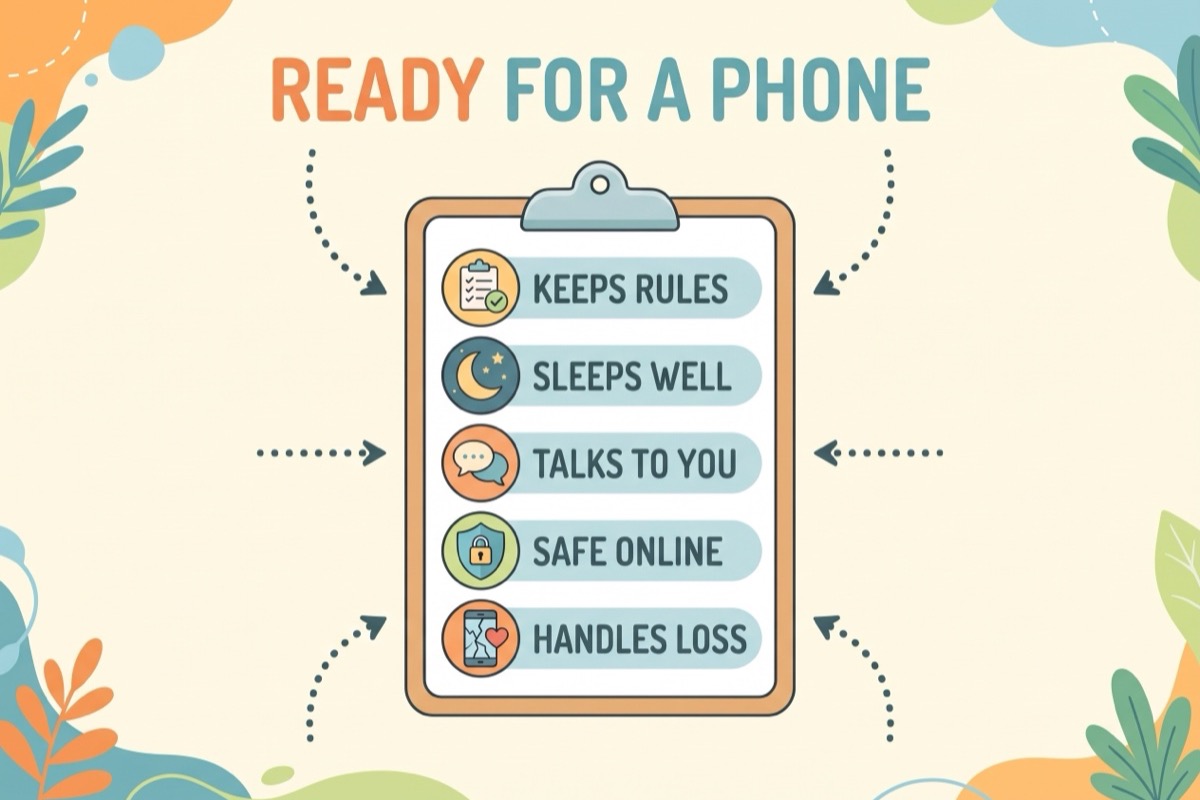
Age tells you what is typical. Readiness tells you what is likely to go well. These items combine the AAP's three factors, the Child Mind Institute's list and CHOP's rules-first advice, plus two practical ones of our own. Go through them with your child, not about them.
Signs your child is ready for more than calls and texts
- Keeps track of things that matter. Responsibility with belongings is first on the Child Mind list. If jackets and library books mostly come home, good sign. If not, a pocket computer is a hard place to start practicing.
- Resists in-app purchases and "just one more" offers. Impulse control is on both lists. Watch how they handle the tablet or console they already use.
- Uses good judgment in texts. Kind, not cruel. Knows when to stop replying. Knows when to show you something.
- Understands that posts are permanent. If they can explain in their own words why a deleted message is not really gone, check the box.
- Already follows the screen limits you have. The last Child Mind factor, and the easiest to observe. A kid who fights every tablet limit will fight phone limits too, just with a better device.
- Tells you when something online goes wrong. Not on either list word for word, but it is judgment in practice. The deal has to be that telling you does not automatically mean losing the device.
- Has a real reason to need one. Walking home, two households, activities without you there. The need decides where to start, not the class list.
- Can agree to family rules before the device arrives. This is the CHOP recommendation: rules and phone-free times first, device second.
Most kids will tick some of these and not others. That is normal. It tells you which stage to start at, and what to practice while you wait.
The Staged Path: Watch, Smartphone With Limits, Then Social Media
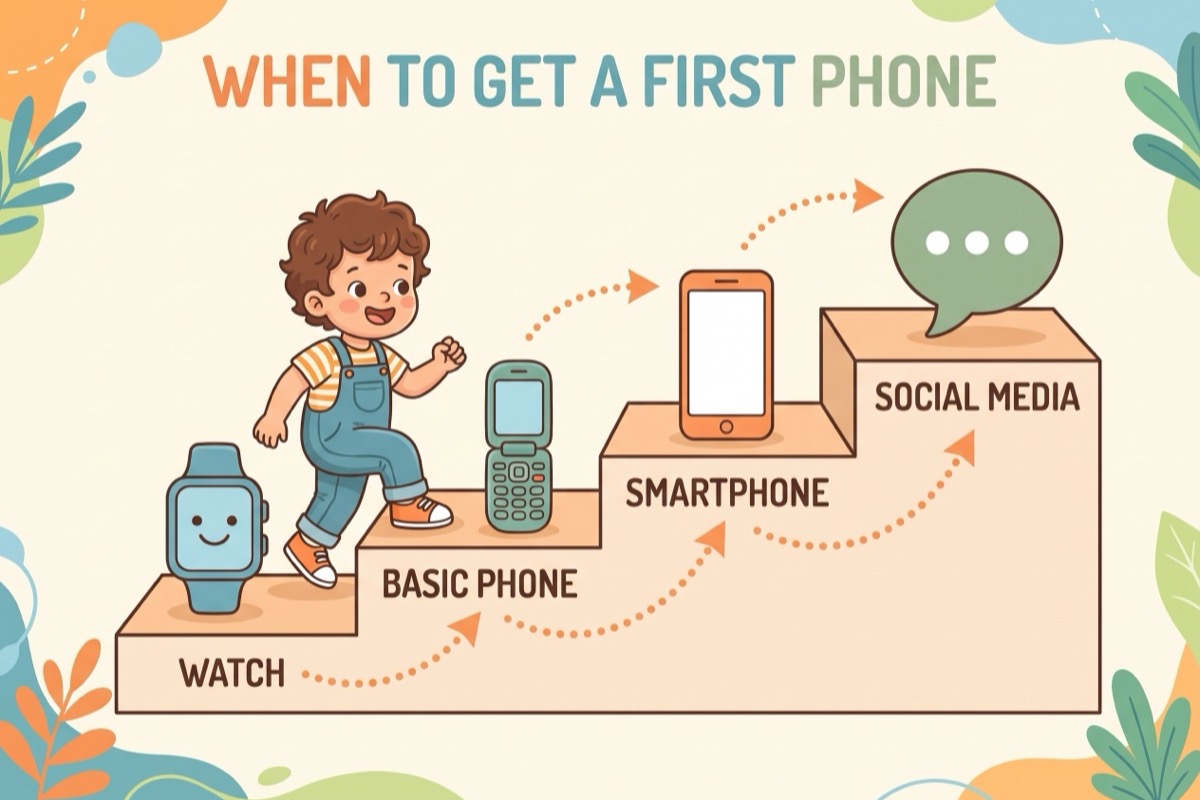
Both the US and UK pledges build a pre-smartphone stage into their rules, and the AAP suggests the same thing. Think of it as three steps, each earned rather than scheduled by birthday.
Stage 1: A smartwatch or basic phone
Calls and texts with people you approve. This covers the main job of a first phone, reaching you, and it fits both the AAP's interim suggestion and the basic phone Wait Until 8th allows. Use this stage to practice the checklist with low stakes: keeping it charged, not losing it, answering when you call.
Stage 2: A smartphone with limits switched on first
When the checklist mostly holds, the smartphone arrives with settings already on. On an iPhone, Apple's Screen Time handles the two that matter most at the start. On Android, Google's Family Link does the time limits.
- Who they can contact (Communication Limits): Settings > Family > [child's name] > Allowed Contacts.
- What they can see and download: Settings > Family > [child's name] > Content & Privacy Restrictions.
- Daily limits on Android: Family Link app > select your child > Screen time > Time limits.
One trap: Family Link supervises Android devices, Chromebooks and compatible Fitbits, not iPhones or iPads. If your child has an iPhone, Screen Time is the tool. Our 15-minute iPhone parental controls setup walks through the rest.
Stage 3: Social media, as a separate yes
The AAP says at least 13. The UK's Smartphone Free Childhood Parent Pact says "no smartphones until 14, no social media until 16." Australia went further by law on December 10, 2025. Under-16s there are barred from accounts on Facebook, Instagram, Snapchat, Threads, TikTok, Twitch, X, YouTube, Kick and Reddit, with penalties on the platforms rather than on families. That law does not apply in the US, but 13 is clearly no longer the only number on the table. Our look at what towns and countries actually did covers the pledges and laws in more detail.
Write the Rules Before You Hand It Over
CHOP's advice is the least glamorous part of the research and probably the most useful: agree on rules and phone-free times before the device arrives. Once the box is open, every new rule feels like a punishment. Before, it is just the deal. A first agreement can be short:
- Where the phone sleeps. Insufficient sleep showed up in all three 2026 findings above, so overnight charging outside the bedroom is the rule I would write first.
- Phone-free times. Meals, homework, the hour before bed. Pick the ones you will actually hold.
- Who they can contact. Family and approved friends to start. That is what Allowed Contacts is for.
- What needs a yes. New apps, new accounts, anything that costs money.
- What happens when a rule slips. Decided calmly now, not in the heat of it.
- When you review it. A date on the calendar, so "not yet" becomes "let's look again then."
Rules that live in a parent's head get renegotiated nightly. Rules on paper, somewhere the whole family can see them, get pointed at instead of argued about.
What Does Not Work
None of these make anyone a bad parent. Most of us have tried at least one. They just make the next year harder.
- Picking the age the class picked. Peer timing is real pressure, and it is exactly why the Wait Until 8th pledge only activates once at least 10 families from the same grade and school have signed. One family holding out alone is much harder than ten holding out together.
- Treating 13 as a safety rating. It is a privacy-law threshold. In the 2026 study, kids who got a smartphone at 13 still had higher odds of clinical psychopathology and insufficient sleep than peers who stayed phone-free.
- Handing over the phone, then writing the rules. Rules added after the fact read as punishment. Rules agreed before read as the terms.
- Counting on settings alone. Settings enforce an agreement. They do not replace it, and they differ by device: Family Link will not supervise an iPhone.
- Reading the 2026 study as a verdict. The findings are associations. Use them to justify a staged start and firm sleep rules, not to scare a 12-year-old.
- Making it all or nothing. "No smartphone until 14" is much easier to hold when a watch or basic phone covers the need in between.
A Four-Week Plan Before the First Phone
If the question is live in your house, this month gets you from "everyone has one" to a decision you can explain to your kid.
| Week | Focus | What you do |
|---|---|---|
| Week 1 | The need | Ask what the phone is for. Sort the answers into "needs to reach you" and "wants the internet." They lead to different stages. |
| Week 2 | The checklist | Go through the eight readiness items together. Pick the two shakiest and practice them with devices already in the house. |
| Week 3 | The agreement | Write the family rules: charging spot, phone-free times, contacts, what needs a yes, what happens when a rule slips, review date. |
| Week 4 | The stage | Watch or basic phone if the need is reaching you. Smartphone only with Allowed Contacts and Content & Privacy Restrictions (or Family Link time limits) set before the handover. |
The review date matters more than it looks. It turns "no" into "not yet, and here is what we are checking," which is a sentence most kids can live with.
When to Talk to Your Pediatrician
Sleep and mood are two of the areas where the 2026 study found differences, so they are worth watching once any phone arrives. If sleep keeps slipping for weeks, or your child seems persistently low or anxious, bring it to your pediatrician and mention when the phone arrived. Our guide to screen addiction in kids covers how to tell a pattern from a rough week. A similar age question comes up with money: what age should a child have a savings account.
Key Takeaways
- There is no single right age. The AAP says to judge responsibility, impulse control and judgment, not birthdays.
- Typical is around 11 for a first smartphone in the US. Two smaller studies put the average first phone of any kind at 11.6 and 12.2, so check the source and year.
- A phone and a smartphone are different decisions. A watch or basic phone covers the need to reach you.
- 13 is a privacy-law line, not a readiness line. It comes from COPPA.
- The 2026 Pediatrics study linked owning a smartphone at 12 with higher odds of depression, obesity and insufficient sleep. Associations, not proof, but a solid reason for a staged start.
- Rules first, device second. Charging spot and phone-free times go on paper before the handover.
Frequently Asked Questions
What age should a child get a phone?
There is no single right age. The AAP tells parents to judge responsibility, impulse control and judgment instead. Many families start with a smartwatch or basic phone, move to a smartphone with limits once the child is ready, and treat social media as a later decision. Most US kids get a first smartphone around 11, while the Wait Until 8th pledge aims for the end of 8th grade.
What is a good first phone for kids?
For most kids, one that calls and texts and not much else. The AAP suggests a flip phone or smartwatch as an interim option, and the Wait Until 8th pledge allows a basic phone that just calls and texts. It covers the real need, reaching you, and lets your child practice responsibility before a browser and an app store come along.
What is the Wait Until 8th pledge?
Parents promise not to give their child a smartphone until at least the end of 8th grade. The pledge only activates once at least 10 families from the child's grade and school have signed, so no family holds out alone. A basic phone for calls and texts is allowed in the meantime.
Is 13 a safe age for social media?
Thirteen is a legal line, not a safety rating. It comes from COPPA, the US privacy law that requires child-directed online services to get parental consent before collecting data from children under 13. The AAP recommends waiting until at least 13 but notes the number does not come from developmental research. The UK Parent Pact suggests 16, and Australia barred under-16s from major platforms in December 2025.
How many kids have a phone by 12?
In Common Sense Media's 2021 census, about 7 in 10 of 12- and 13-year-olds owned a phone. That compares with about 3 in 10 at ages 8 and 9 and about 9 in 10 at 14 and older. By the teen years it is close to universal: Pew's 2024 survey found 95% of US teens aged 13 to 17 have or have access to a smartphone.
Does getting a phone early cause depression?
The research shows links, not proof of cause. A January 2026 study in Pediatrics of 10,588 kids found 12-year-olds with a smartphone had higher odds of depression, obesity and insufficient sleep than those without one. The researchers recommend approaching the decision with care and setting family rules and phone-free times before handing a phone over.
Related Reading
- Social Media Age Limits: The Main Apps, Laws and Countries (2026)
- Smartphone Free Childhood: What Towns and Countries Actually Did (2026)
- Parental Controls on iPhone: A 15-Minute Setup for Kids (2026)
- Screen Addiction in Kids: 9 Signs and How to Break the Loop (2026)
- How to Check Screen Time on Android and Limit It for Kids (2026)
- Recommended Screen Time by Age: What the Guidelines Say (2026)
Turn your phone rules into a checklist your kids can see
Charging spot, phone-free dinners, homework before screens. Our free maker turns your family's screen rules into a daily chart for the fridge or the app, so nobody has to remember them from a conversation last month.
Make a free screen rules chart
