Social Media Age Limits: The Main Apps, Laws and Countries (2026)
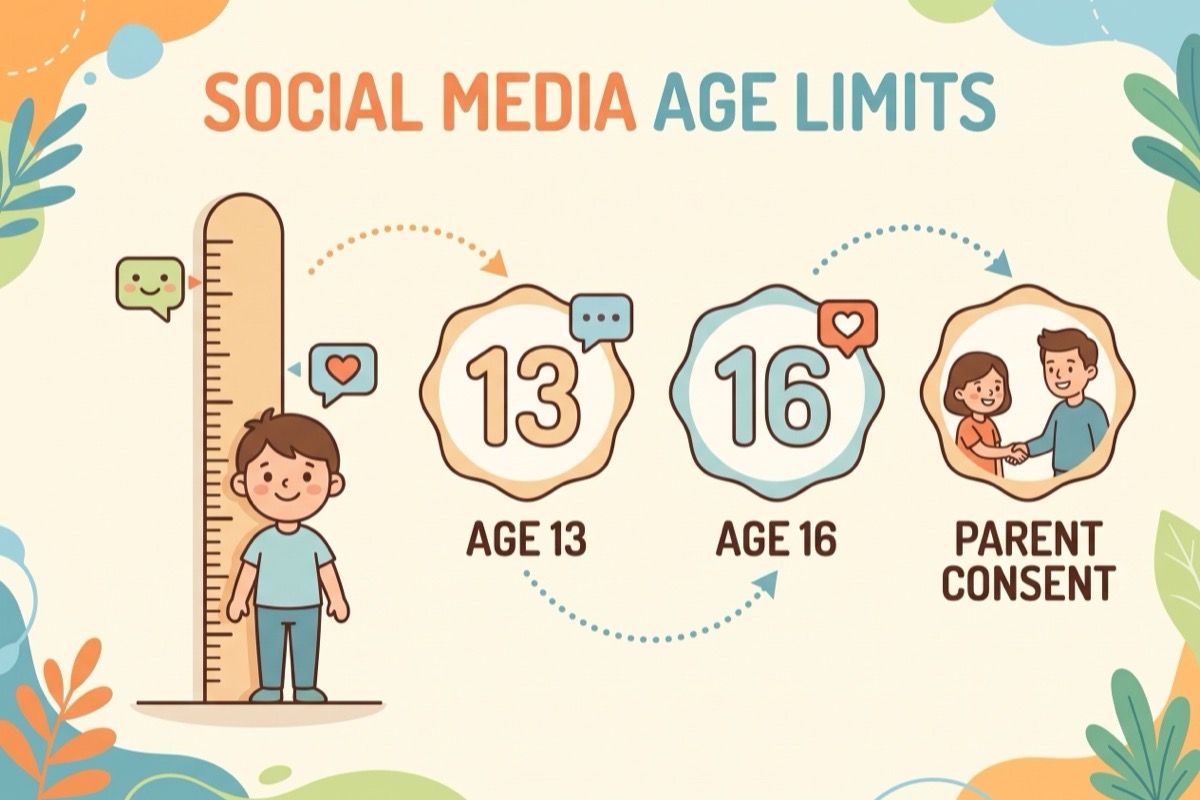
Ask a room of parents about social media age limits and you will hear one number: 13. It is the minimum age on Instagram, TikTok, Snapchat and Discord, and it is the first card most of us play when a 10-year-old asks for an account. Fewer people know where the number came from. It started as a US privacy rule about companies collecting children's data. It was never chosen as the age a child is ready for a feed.
Thirteen is also no longer the only number. Australia now bars under-16s from holding accounts on major platforms. A 2023 French law tells platforms to turn away under-15s unless a parent says yes, and in parts of Europe the same app can mean 14 or 16. Below: why 13 exists, what the surveys found, one table by app, one by country, and a plan for deciding at home. If the phone itself is still an open question, start with our guide to what age a child should get a phone.
Why 13? What the Law Actually Says
The American number comes from COPPA, the Children's Online Privacy Protection Rule. The FTC's COPPA rule is codified at 16 CFR Part 312. It applies to online services "directed to children under 13 years of age," and to operators who know they are collecting personal data from a child under 13. It governs data and parental consent. It does not bar a 12-year-old from using a website.
Why 13 in particular? The FTC says Congress covered only under-13s because "younger children are particularly vulnerable to overreaching by marketers and may not understand the safety and privacy issues" of online data collection. That is an argument about marketing and privacy. Group chats, streaks and scrolling at 11 p.m. do not come into it.
Because the rule is built around under-13s, 13 became the baseline sign-up age for most big platforms. Pediatricians are blunt about what that means. The American Academy of Pediatrics describes 13 as "the age set by COPPA... for regulatory reasons," not a finding from child-development research. Its answer to the readiness question is that it varies: "One 13-year-old may be ready for a social media account, but another 16-year-old may not be."
So the age on the sign-up screen tells you where the privacy rules change. It does not tell you whether your child is ready.
What the Surgeon General and the Surveys Found
In 2023 the US Surgeon General issued an advisory called "Social Media and Youth Mental Health." Its full text reports that "up to 95% of youth ages 13-17 report using a social media platform," and that more than a third describe their use as "almost constant." It also reports that nearly 40% of children ages 8 to 12 use social media, despite the age-13 minimum on the platforms.
Common Sense Media's 2021 census of tweens and teens landed in the same place: 38% of 8- to 12-year-olds had used social media, up from 31% in 2019. The report itself notes that tweens "are technically not supposed to be using social media in the first place." Their top sites were Snapchat (13%), Instagram (10%) and Facebook (8%).
For teens, the most recent numbers come from Pew Research Center. It surveyed 1,391 US teens ages 13 to 17, and a parent of each, between September 18 and October 10, 2024. Nine in ten teens use YouTube. Majorities use TikTok (63%), Instagram (61%) and Snapchat (55%).
The age limit is a line in the terms of service, and a large share of 8- to 12-year-olds already ignore it. When your 11-year-old says "everyone has it," they are exaggerating. Just not by as much as you would like.
Social Media Age Limits by App
These are the minimum ages the platforms state on their own pages, plus the country exceptions they publish. They are sign-up rules, not recommendations.
| App | Minimum age | Worth knowing |
|---|---|---|
| 13 | Every account aged 13–17 is a Teen Account with extra default protections. No parental approval is needed to open one | |
| TikTok | 13 | Stated in TikTok's "Age Appropriate Experiences" policy |
| Snapchat | 13 as the baseline | Local law may set a different minimum age, for the app or for certain features |
| YouTube (Google Account) | 13 in most countries; 14 in countries such as Austria, Cyprus and Italy; 16 in countries such as Germany, Ireland, the Netherlands and Poland | Below the minimum, only YouTube Kids or a parent-managed supervised account |
| Discord | 13 | May also bar users over 13 where local law sets an older age |
| Roblox | No single sign-up age | Roblox Kids (5–8), Roblox Select (9–15), a standard account after age verification at 16 or older |
Instagram. Meta's Teen Accounts page lists the defaults that apply to every account aged 13 to 17. They include a private account, restricted messaging, and offensive comments and requests hidden automatically. There is also a sleep mode that mutes notifications from 10 p.m. to 7 a.m., and a reminder to close the app after 60 minutes of use in a day. For 13- to 15-year-olds, a parent has to approve before certain of those settings can be loosened. Opening the account in the first place needs no parental approval at all.
One mix-up to avoid: Instagram's "Set Up a Minimum Age" feature lets Business and Creator accounts limit who sees their own content. It controls an audience, not how old your child must be to sign up.
YouTube. YouTube runs on a Google Account, so Google's age requirements page is the one to bookmark, because it lists the country exceptions. Below the minimum, a child can use YouTube only through the separate YouTube Kids app or a supervised account that a parent manages. The same page describes the Family Link route for setting that up.
Roblox. It is a game platform, but its chat puts it in the same conversation. Roblox Kids, for ages 5 to 8, has all communication off by default. Roblox Select, for ages 9 to 15, uses standard communication settings.
Social Media Age Limits by Country
An app's own minimum is the floor. Local law can raise it, and recently some places have. If you are looking up social media age by country, this table covers the main rules. The law here is moving, so check the date on anything you read, including this.
| Place | The rule | What it means for families |
|---|---|---|
| United States | COPPA: services aimed at children under 13, or that knowingly collect data from them, fall under federal privacy and parental-consent rules | A privacy rule, not a ban. It is where the usual 13 comes from |
| European Union | GDPR Article 8: 16 is the default age at which a child can consent on their own to data processing by online services. Each country may lower it, but "not below 13" | A 13-to-16 patchwork. Google, for example, uses 14 in Austria, Cyprus and Italy and 16 in Germany, Ireland, the Netherlands and Poland |
| France | "Digital majority" law of July 7, 2023: social media platforms must "refuse registration" to under-15s unless a parent authorizes it | Under 15, a parent signs off. Platforms that skip certified age-verification tools face fines of up to 1% of worldwide annual revenue |
| United Kingdom | Online Safety Act: platforms children can access must run age checks, such as facial age estimation, photo-ID matching or credit-card checks | Keeping children from pornography and other harmful content, and making sure "strangers have no way of messaging children" |
| South Korea | Personal Information Protection Act: a parent or guardian must consent before an operator processes the personal data of anyone under 14 | Under 14, a parent's consent is needed before an app can process your child's personal data |
| Australia | Social Media Minimum Age Act 2024: platforms must take "reasonable steps" to stop under-16s having accounts, in effect since December 10, 2025 | Named platforms include Facebook, Instagram, Snapchat, TikTok, X, Reddit and YouTube. Under-16s can still watch YouTube logged out |
Australia's rule is often misreported. The Online Safety Amendment (Social Media Minimum Age) Act 2024 defines an "age-restricted user" as "an Australian child who has not reached 16 years." It was assented to on December 10, 2024 and commenced the next day. The account restriction itself only took effect a year later, on December 10, 2025.
YouTube was expected to be exempt when the law passed. That changed in July 2025, after a survey of 2,600 children found 37% had encountered harmful content on YouTube, the worst rate of any platform surveyed. An ABC News explainer lists YouTube alongside Facebook, Instagram, Snapchat, TikTok, X and Reddit as covered platforms. Under-16s in Australia can still watch YouTube while logged out, but they cannot hold an account, comment or upload.
Europe and the UK take different routes. GDPR Article 8 is, like COPPA, a data-consent rule, which is why age restrictions for social media can differ for the same app from one EU country to the next. The UK government's explainer is about age checks, what children see and who can contact them; its August 1, 2025 statement called those duties now in force.
Laws are only one lever. For what families, towns and countries have done beyond them, see our piece on a smartphone-free childhood.
The Birthday Box Problem
Almost every limit above rests on one thing: the birthday your child types in. Self-declared birthdates were the norm across most platforms before the UK's age checks took effect in 2025, and most countries still rely on them. The survey numbers above show how well that works.
The less obvious cost is what a fake birthday switches off. Instagram's Teen Account protections follow the age entered at signup. An account that says 18 does not get the private default, the sleep mode or the 60-minute reminder, whatever the real age of the person holding the phone. The same goes for a parent who fudges the year to get a younger child into the family group chat.
So if your child is under an app's minimum, skip the creative birthday. Try an honest "not yet" with a date to revisit, or a version built for their age: YouTube Kids, a supervised Google account, or Roblox Kids and Select. A rule with a reason and an end date is easier to live with than a flat no.
How to Decide at Home
Age is a floor, not a readiness test. Once your child is past the floor, the call is yours. Here is how we would work through it.
- Separate watching, messaging and posting. Watching YouTube, texting grandparents on WhatsApp and posting to a public feed are three different requests. Australia's law draws a similar line: logged-out watching is allowed, an account is not.
- Check the floor for your child's age and country. Use the two tables above. If your child is under the minimum, the app has made this year's decision for you.
- Look at readiness, not the birthday. The signs we would look for: they tell you when something online upsets them and know what to do if a stranger messages them. Most days, they also stop when time is up without a battle.
- Set it up together, with the real birthday. That keeps whatever teen protections the app offers switched on. On Instagram, go through the Teen Account defaults side by side, so nothing is a surprise later.
- Write the house rules down. Which apps, where devices sleep, and what to do when something feels wrong. Instagram's sleep mode mutes notifications from 10 p.m. to 7 a.m.; a charger in the kitchen quiets every app at once.
- Start with one app. Add a second after a month that went reasonably well. Widening a rule is easier than taking one back.
- Back it up on the device. Our guide to parental controls on iPhone walks through the settings side. Settings are the fence; the agreement is why the fence is there.
What Does Not Work
- Treating 13 as a readiness verdict. It is a privacy line. The FTC's own explanation says so, and so does the AAP.
- Counting on the sign-up screen. In most countries it still asks for a birthday and believes the answer.
- Fudging the birthday "just for now." It switches off the teen protections at the same time, and it teaches that rules bend if you type the right number.
- One rule for every app. YouTube videos, a family WhatsApp group and a public TikTok are not the same thing, and your rules do not have to pretend they are.
- Rules only the kids follow. If your phone comes to dinner, theirs will be up for negotiation too.
- Panic. Nearly 40% of 8- to 12-year-olds use social media, according to the Surgeon General's advisory. If your family is sorting this out late, you have plenty of company. A plan helps more than guilt.
A Four-Week Plan for a First Account
| Week | What to do | What you are after |
|---|---|---|
| Week 1 | Talk it through: which app, what for, who they want to reach. Check the tables above for its minimum age and your country's rule | The real request, not the headline |
| Week 2 | If yes, set up the account together with the real birthday and walk through the default protections. If not yet, pick the version for their age and set a date to revisit | An account that matches their age |
| Week 3 | Write the house rules and put them where everyone can see them: which apps, where devices sleep at night, what to do when something online feels wrong | One version of the rules |
| Week 4 | Review together. Keep what worked, change one thing, and decide whether a second app is on the table yet | A plan that grows with them |
When to Pause or Get Help
If social media starts crowding out sleep, school or friends, or putting the phone down becomes a daily fight, pause the new app and talk before you add settings. If changes in mood or sleep last for weeks, call your pediatrician. Our guide to screen addiction in kids covers the warning signs and how to reset. And if your child tells you about a message that upset them, thank them first. That habit is worth more than any setting.
Key Takeaways
- 13 comes from a privacy law. COPPA covers data collected from under-13s, and the AAP calls 13 a regulatory age, not a readiness age.
- Most big apps say 13. Instagram, TikTok, Snapchat and Discord do, and so does Google, including YouTube, in most countries.
- The number moves with the country. Google uses 14 or 16 in parts of the EU, South Korea's privacy law requires a parent's consent under 14, and France brings in a parent under 15.
- Australia sets 16 by law. Since December 10, 2025, under-16s cannot hold accounts on platforms including Instagram, TikTok, Snapchat and YouTube.
- Plenty of kids are already under the line. Nearly 40% of 8- to 12-year-olds use social media, per the Surgeon General's 2023 advisory.
- A fake birthday switches off the protections too. Instagram's Teen Account defaults follow the age entered at signup.
- Decide by readiness, one app at a time, and write the house rules down.
Frequently Asked Questions
What are the social media age limits for the main apps?
Instagram, TikTok, Snapchat and Discord all set 13 as their minimum age, and Google uses 13 for its accounts, including YouTube, in most countries. The number can go up: Google uses 14 or 16 in parts of the EU, and Snapchat and Discord both say local law can set a different age. Roblox has no single sign-up age and uses age-banded accounts instead.
Why is 13 the minimum age for social media?
Because of COPPA, the US privacy rule covering services that collect personal data from children under 13. The FTC says Congress drew the line there because younger children are particularly vulnerable to marketers and may not understand online privacy issues. The AAP calls 13 an age set for regulatory reasons, not a sign that a child is ready.
Is it illegal for a child under 13 to use social media in the US?
Not under COPPA, the federal rule behind the 13. COPPA is a data-privacy and parental-consent rule for companies that collect data from children under 13. It does not bar children from using a site. The limit your child runs into is the platform's own terms, which usually say 13. The Surgeon General's 2023 advisory reported that nearly 40% of children ages 8 to 12 use social media anyway.
What age do you have to be for TikTok and Instagram?
13 for both. On Instagram, every account aged 13 to 17 is a Teen Account with default protections such as a private account and restricted messaging. No parental approval is needed to create it, but a parent must approve loosening certain settings for 13- to 15-year-olds. Local law can set a higher age: a 2023 French law requires a parent's authorization under 15, and Australia bars under-16s from holding accounts on both apps.
Which countries have a social media age limit of 16?
Australia is the clearest case. Since December 10, 2025, platforms must take reasonable steps to stop under-16s having accounts, and the named platforms include Facebook, Instagram, Snapchat, TikTok, X, Reddit and YouTube. In the EU, GDPR Article 8 sets 16 as the default age of digital consent, but each country may lower it to as low as 13. Google uses 16 in Germany, Ireland, the Netherlands and Poland.
Can a child under 13 use YouTube?
Not with a standard account of their own. Google says children under the minimum age can use YouTube only through the separate YouTube Kids app or a supervised account that a parent manages. The minimum is 13 in most countries, and 14 or 16 in some. In Australia, under-16s can watch while logged out but cannot hold an account, comment or upload.
Related Reading
- What Age Should a Child Get a Phone? A Readiness Checklist (2026)
- Smartphone Free Childhood: What Towns and Countries Actually Did (2026)
- Screen Addiction in Kids: 9 Signs and How to Break the Loop (2026)
- Parental Controls on iPhone: A 15-Minute Setup for Kids (2026)
- Roblox Parental Controls: A Parent's Setup Guide (2026)
- Recommended Screen Time by Age: What the Guidelines Say (2026)
Turn your screen rules into a daily checklist the kids can see
Our free chart maker puts app rules next to homework, chores and bedtime on one daily checklist. Print it for the fridge or use the app. No signup required.
Make a free screen rules chart
