Recommended Screen Time by Age: What the Guidelines Say (2026)
Search for recommended screen time by age and you get the same tidy chart: zero for babies, an hour for preschoolers, two for everyone else. It is usually credited to the pediatricians. The catch is that the American Academy of Pediatrics no longer publishes that chart. Its January 2026 policy statement replaced its earlier media guidance, and it sets no hour limit at any age.
That does not leave you with nothing. The AAP now offers a five-part framework instead of a number, and three other bodies still publish limits. Here is the short version.
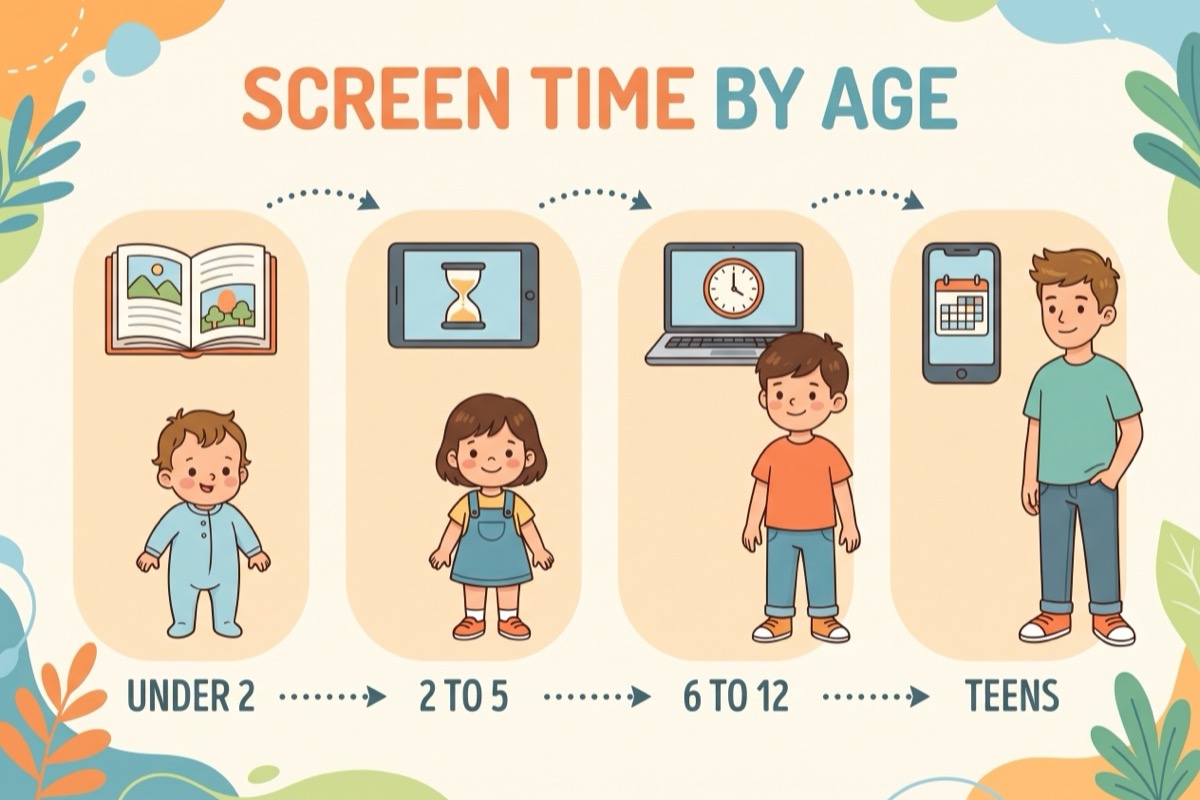
- Under 2: little or no screen time, though the American Academy of Child and Adolescent Psychiatry (AACAP) allows video chat with an adult.
- Ages 2 to 5: about 1 hour a day, per the World Health Organization (for ages 2 to 4), AACAP and Sweden's Public Health Agency.
- Ages 6 to 12: no more than 1 to 2 hours a day, from Sweden.
- Ages 13 to 18: no more than 2 to 3 hours a day, also from Sweden.
Below: whose number is whose, what kids actually spend, and a school-day and weekend plan you can start this week. If your child is under 2, our guide to infant and toddler screen time goes deeper.
What the AAP Says Now (and Why There Is No Number)
The new statement is called "Digital Ecosystems, Children, and Adolescents." It appeared in the February 2026 issue of Pediatrics, and the published statement explicitly replaces the AAP's prior guidance on communications and media.
The AAP's own announcement is plain about it: the policy contains no specific screen-time hour recommendation. It focuses on "systems-level changes, design principles, parental strategies like Family Media Plans," with the child at the center. The lead author, Dr. Tiffany Munzer, put it this way: "When digital media are designed with children's wellbeing as the north star, young people can experience benefits, such as learning and social connection."
In place of an hour count, the AAP points families to the 5 Cs of Media Use: Child, Content, Calm, Crowding Out and Communication. Its site for parents, HealthyChildren.org, hosts an interactive Family Media Plan for turning those into house rules.
Why drop the number? The 5 Cs hint at the reason. A slow, well-made show watched together on the couch and autoplay alone in a bedroom can both last "one hour," and they are not the same hour. The question moves from how long to what, with whom, and instead of what.
One practical consequence: if a chart on your fridge says "the AAP recommends X hours," it is out of date. Plenty of articles, including some written in 2024 and 2025, still print one. Some of those charts are not even the AAP's, as you will see below.
Recommended Screen Time by Age: Every Official Number in One Table
A number can be a useful guardrail as long as you know whose it is. Read across a row: the sources mostly agree for little kids and thin out fast after age 5.
| Age | AAP (2026) | WHO (2019) | AACAP (2025) | Sweden (2024) |
|---|---|---|---|---|
| Under 12 months | No hour number; use the 5 Cs and a Family Media Plan | Screen time not recommended | Video chatting with an adult only | Preferably no screens at all |
| 12–18 months | No hour number | Sedentary screen time not recommended | Video chatting with an adult only | Preferably no screens at all |
| 18–24 months | No hour number | Sedentary screen time not recommended | Educational programming, watched together with a caregiver | Preferably no screens at all |
| 2–5 years | No hour number | Ages 2–4: no more than 1 hour a day; less is better | About 1 hour of non-educational screen time on weekdays, 3 hours on weekend days | No more than 1 hour a day |
| 6–12 years | No hour number | Not covered (under-5s only) | "Encourage healthy habits and limit activities that include screens"; no hour cap | No more than 1–2 hours a day |
| 13–17 years | No hour number | Not covered (under-5s only) | Same as ages 6 and up; no hour cap | No more than 2–3 hours a day (ages 13–18) |
Three things to keep in mind when you read it.
- "Screen time" does not mean the same thing in every column. WHO counts sedentary screen time: watching TV or videos, playing computer games. Sweden and AACAP generally mean leisure use, not schoolwork, video calls or accessibility aids. Line the numbers up, but do not treat them as one measurement.
- WHO stops at age 4. Its 2019 guidelines, released in April 2019 and its first ever on this for young children, cover only kids under 5. There is no WHO hour limit for a 9-year-old, whatever the meme says.
- Sweden's numbers are advice, not law. The 2024 recommendations from Folkhälsomyndigheten, Sweden's Public Health Agency, are its first such guidance and are framed as "a good rule of thumb." Headlines about Sweden "banning" screens for toddlers got that part wrong.
Where the Numbers You See Online Actually Come From
Most screen-time charts online are built from these same sources, then shuffled until the labels fall off. Five mix-ups come up again and again.
- "The AAP says 1 hour on weekdays and 3 on weekends for ages 2–5." That is AACAP's wording, from its Screen Time and Children guide for families, updated in June 2025. Accurate, just not the AAP's.
- "The AAP says 2 hours a day for older kids." Retired. The 2026 policy statement replaced the AAP's earlier media guidance and has no hour figure.
- "WHO says 2 hours for school-age kids." WHO's numeric screen guidance covers children under 5 only.
- "The CDC recommends 30 minutes a week." That figure comes from a 2010 CDC obesity-prevention standard for childcare programs. It tells providers not to use screen media at all with children under 2. For children 2 and older, total media time in care stays at 30 minutes a week or less, only for educational or physical-activity purposes. It is about daycare, not your living room.
- "Sweden banned screens for toddlers." It recommended; it did not ban. Nobody in Stockholm is being fined over a cartoon.
None of this makes the numbers useless. It just means you should know which body you are borrowing from, and that from age 6 the only official hour limits in this article come from Sweden.
How Much Screen Time Kids Actually Get
Guidance is one thing; a rainy Saturday is another. The 2025 Common Sense Census, published in February 2025, found that screen time for children 0–8 "remains steady at about 2.5 hours per day." Gaming time is up 65% over four years, while traditional TV viewing is declining. And 40% of children have a tablet by age 2, while nearly 1 in 4 have a personal cellphone by age 8.
For older kids, the most recent Common Sense breakdown comes from a 2021 survey. Tweens 8–12 averaged 5 hours 33 minutes of entertainment screen media a day, and teens 13–18 averaged 8 hours 39 minutes, not counting school use. AACAP's family guide puts the average for US kids 8–18 at 7.5 hours a day of watching or using screens.
So if your 10-year-old is well past Sweden's one to two hours, you have a lot of company. That is not a verdict on anyone's parenting. It is a sign that a number on its own rarely holds up against a real week.
Quality Over Quantity: The 5 Cs, Translated for a Tuesday
The AAP describes the 5 Cs as a mnemonic for pediatricians and parents to talk about media use. It is a conversation tool, not a scorecard. The five words are the AAP's; how we turn each one into something you can use on a school night is our own translation.
- Child. Start with the kid, not the clock. The same show can settle one child and wind up another. A 6-year-old and a 12-year-old sit in the same row of the table and still need different rules.
- Content. Look at what fills the time. HealthyChildren.org suggests choosing apps and shows that "teach, inspire creativity and encourage social connection," and avoiding content with heavy ads or material that is wrong for their age.
- Calm. Notice whether a screen is one way your child settles down or the only way. If it is the only way, build a second one: a bath, a book, a lap around the block.
- Crowding Out. Check what the screen time replaced. An hour that pushed out outdoor play or sleep costs more than an hour that replaced staring at the ceiling. Sweden's bedtime advice is a crowding-out rule in disguise.
- Communication. Talk about what they watch and play, and sometimes watch or play with them. AACAP's advice for 18–24 months is built on watching together.
This is where the AAP, AACAP and Sweden quietly agree. The AAP has the 5 Cs. AACAP splits educational from non-educational time for 2- to 5-year-olds. Sweden pairs its numbers with two sleep rules for every age.
A Realistic School Day and Weekend, by Age
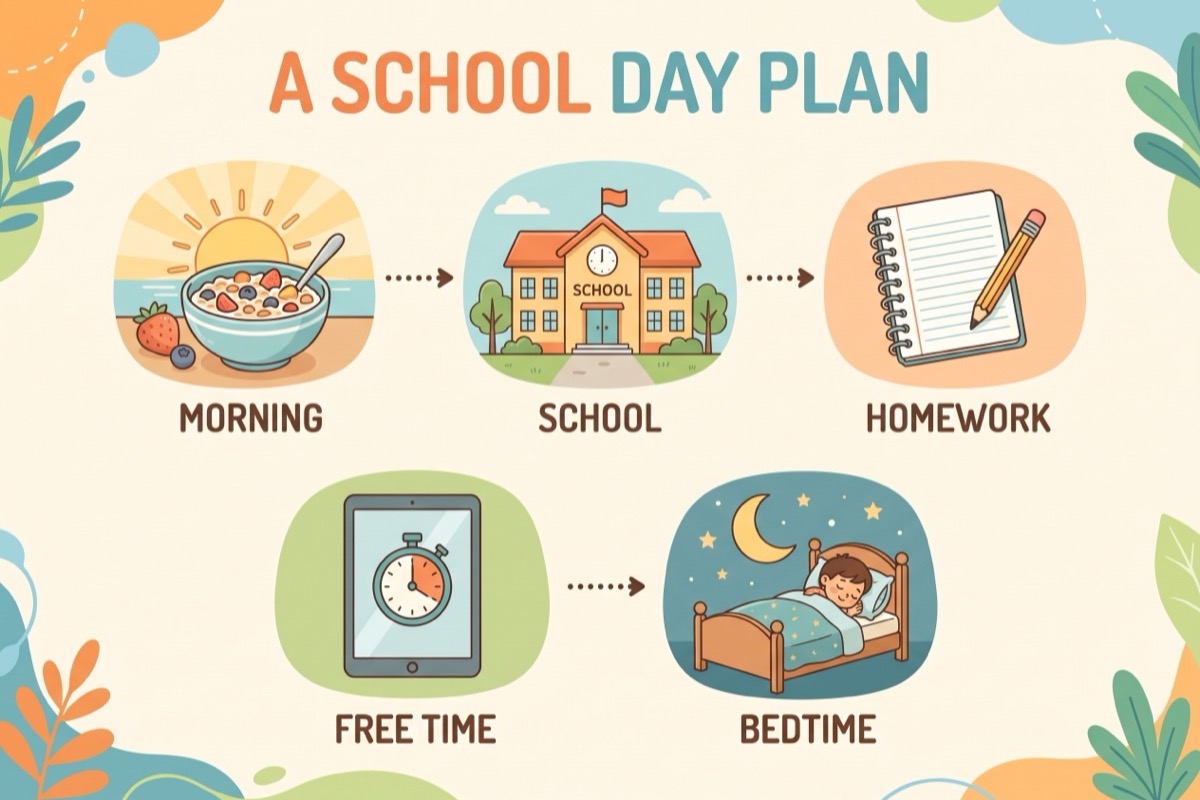
Here is how we would turn the table into an ordinary week. The limits are the other bodies' numbers, credited to them; the rest is kitchen-table logistics. Adjust with the 5 Cs, not with guilt.
| Age | School day | Weekend |
|---|---|---|
| Under 2 | Video calls with family, if any. WHO and Sweden advise against screens at this age; AACAP allows video chat with an adult, plus educational shows watched together from 18 months | Same as a weekday. Before 18 months, video calls with grandparents are the one screen use AACAP allows |
| 2–5 | Up to about 1 hour, chosen together (WHO for ages 2–4, AACAP, Sweden). Stop at the end of an episode, not mid-cliffhanger | AACAP allows up to 3 hours of non-educational screen time on weekend days; WHO and Sweden keep the 1-hour rule every day. A family movie watched together is a fair weekend exception |
| 6–12 | Leisure screens after homework and evening jobs, inside Sweden's rule of thumb of 1–2 hours. Schoolwork on a screen is generally outside that count | Same rule of thumb. One planned longer session, like a movie or a game with a friend, usually beats screens drip-fed all day |
| 13–17 | Up to 2–3 hours of leisure screens (Sweden, ages 13–18). Let them propose the plan; you hold the line on sleep and school | Same range, written down. Teens argue less with a deal they drafted themselves. Usually |
For every age, Sweden adds two rules worth keeping whatever number you pick: screens off 30–60 minutes before bedtime, and phones, tablets and similar devices outside the bedroom overnight. They cost nothing, and they close the loophole every parent knows: the phone under the pillow at 11 p.m.
Building a Family Media Plan That Survives a School Night
The AAP's answer to "how much" is a plan, and the Family Media Plan tool on HealthyChildren.org is a decent skeleton. Here is the order we would fill it in.
- Write down a real weekday and a real weekend day. When screens come out, what is on, and what they replace. No new rules yet.
- Choose your guardrail and name its source. "We are using Sweden's 1–2 hours for our 8-year-old" is a sentence you can defend at dinner. "Because I said so" has a shorter shelf life.
- Set the sleep rules first. Screens off before bed, chargers outside the bedroom. They are the easiest rules to check and the hardest to argue with.
- Agree what content is in and what is out. Use the teach, create, connect test, and name the ad-heavy apps that stay off.
- Decide what happens when time is up. A warning, the end of the episode, then off. Decide it once, not every night.
- Back it up with settings. Our guides to parental controls on iPhone and screen time limits on Android walk through the setup. Settings are the fence; the plan is the agreement about why the fence is there.
- Review in four weeks. Kids change, school terms change, and the plan should change with them.
What Does Not Work
- Treating one number as the law. The sources disagree after age 5, and none of them is legislation. A number is a guardrail, not a verdict.
- Counting every minute the same. A video call with a grandparent and an hour of autoplay are not the same hour. AACAP's own guidance makes room for video chat even for babies.
- Rules only the kids follow. It is a family plan for a reason. If your phone comes to dinner, theirs will be up for negotiation too.
- Using a screen as the only off switch. It works tonight. It also leaves you with exactly one tool the next time.
- Rules that live only in your head. Kids argue with memory. They argue less with a chart they can see.
- Shame. Going by the averages above, plenty of families are over someone's limit. Guilt does not change the routine; a plan does.
Your First Week: A 7-Day Plan
| Day | What to do | What you are after |
|---|---|---|
| Days 1–2 | Observe. Jot down when screens come out, which apps, and what they replaced | A baseline, not a guess |
| Day 3 | Pick your guardrail from the table and name whose number it is | A starting point you can explain |
| Day 4 | Family talk. Walk through the 5 Cs; let kids 8 and up draft their own weekday and weekend limits | Buy-in |
| Day 5 | Sleep rules: screens off 30–60 minutes before bed, chargers outside bedrooms | The easiest win |
| Day 6 | Write the plan down, put it on the fridge, and match device limits to it | One version of the rules |
| Day 7 | Review what held and what slipped. Change one thing, not five | A plan that lasts past week one |
When to Talk to Your Pediatrician
Bring it up at the next checkup, or sooner, if screens keep crowding out sleep, school or friends despite a plan. The same goes if switching off turns into a battle most days for weeks. The AAP offers the 5 Cs as a way for pediatricians and parents to talk about media use, so this is a normal checkup topic, not a confession. Our guide to screen addiction in kids covers the warning signs and how to reset.
Key Takeaways
- The AAP no longer sets an hour limit. Its 2026 policy statement replaced earlier guidance and points to the 5 Cs and a Family Media Plan.
- Other bodies still publish numbers. WHO for under-5s, AACAP for young kids, Sweden for every age to 18. Credit each number to whoever said it.
- Under 2, the sources line up. Little or no screen time. AACAP makes room for video calls, and for shared educational viewing from 18 months.
- Ages 2–5: about an hour a day is the common thread across WHO, AACAP and Sweden, with AACAP allowing 3 hours on weekend days.
- From age 6, Sweden's 1–2 hours, and 2–3 for teens, are the only official hour figures here.
- Protect sleep first. Screens off 30–60 minutes before bed, devices out of the bedroom overnight.
- Quality beats the stopwatch. What they watch, who they watch with, and what it replaces matter as much as how long.
Frequently Asked Questions
What is the recommended screen time by age?
It depends on whose guidance you follow. The AAP's 2026 policy statement sets no hour limit at any age and uses the 5 Cs and a Family Media Plan instead. WHO says no screen time under age 1, no sedentary screen time at age 1, and no more than 1 hour a day for ages 2 to 4. AACAP suggests about 1 hour of non-educational screen time on weekdays and 3 on weekend days for ages 2 to 5. Sweden recommends preferably no screens for ages 0 to 2 and up to 1 hour for 2 to 5. For 6 to 12 it suggests 1 to 2 hours, and for 13 to 18, 2 to 3 hours.
Did the AAP drop its screen time limits?
Yes. In January 2026 the AAP released "Digital Ecosystems, Children, and Adolescents," which replaces its earlier guidance on communications and media. The AAP says the statement contains no specific screen-time hour recommendation. Instead it points parents to the 5 Cs of Media Use (Child, Content, Calm, Crowding Out and Communication) and to an interactive Family Media Plan. Charts that still say "the AAP recommends 2 hours" are out of date.
How much screen time should a 7-year-old have?
There is no AAP number for a 7-year-old, and WHO's guidance stops at age 4. AACAP advises encouraging healthy habits and limiting activities that include screens, without an hour cap. The only official number comes from Sweden's Public Health Agency. Its rule of thumb for ages 6 to 12 is "no more than one or two hours a day." That range makes a reasonable guardrail if you want one, adjusted with the 5 Cs.
How much screen time should a toddler have?
Very little. WHO recommends no sedentary screen time for 1-year-olds and no more than 1 hour a day for 2- to 4-year-olds, with less being better. AACAP limits screens to video chatting with an adult under 18 months and to educational programming watched with a caregiver from 18 to 24 months. Sweden recommends that children up to age 2 preferably not use screens at all.
How much is too much screen time?
The AAP no longer defines too much with a number. A practical test borrowed from the 5 Cs is crowding out. If screens are pushing out sleep, school, movement or time with friends and family, it is too much for your child, whatever the clock says. If you want a numeric guardrail, Sweden's rule of thumb is 1 to 2 hours a day for ages 6 to 12 and 2 to 3 hours for teens.
Does homework or video chat count as screen time?
Usually not in the numbers. Sweden's and AACAP's guidance generally cover leisure screen use, not schoolwork, video calls or accessibility aids. AACAP explicitly allows video chatting with an adult even for children under 18 months. Common Sense Media's tween and teen averages also exclude school use. WHO's under-5 guidance is about sedentary screen time, such as watching TV or videos and playing computer games.
Related Reading
- Infant Screen Time: What Babies and Toddlers Really Need (2026)
- Screen Addiction in Kids: 9 Signs and How to Break the Loop (2026)
- Parental Controls on iPhone: A 15-Minute Setup for Kids (2026)
- How to Check Screen Time on Android and Limit It for Kids (2026)
- What Age Should a Child Get a Phone? A Readiness Checklist (2026)
- Social Media Age Limits: The Main Apps, Laws and Countries (2026)
Turn your screen rules into a daily checklist the kids can see
Our free chart maker puts screen time next to homework, chores and bedtime on one daily checklist. Print it for the fridge or use the app. No signup required.
Make a free screen rules chart
