Infant Screen Time: What Babies and Toddlers Really Need (2026)
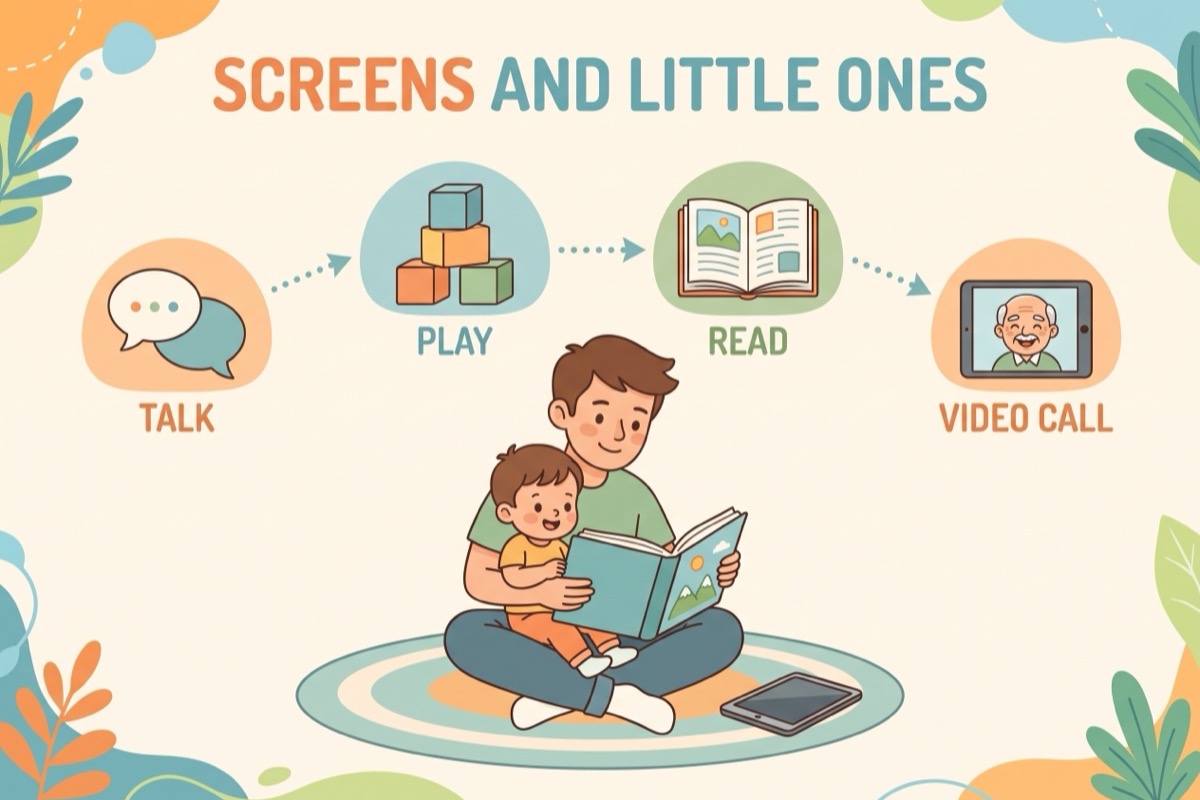
Infant screen time is the one parenting topic where the official advice and real life seem to live in different houses. The guidelines say no screens before 18 months except video calls, then about an hour a day from age 2. Real life says dinner still has to get cooked, the flight still has to be survived, and the tablet is right there on the counter. Most of us land somewhere in between and feel vaguely guilty about it.
This guide is the evidence without the guilt trip. It covers what the guidelines say up to age 5, what changed at the AAP in 2026, which findings are strong, and why a video call with Grandma is different. Then it gets practical about the moments you do reach for a screen. For older kids, our guide to recommended screen time by age picks up where this one stops.
What the Research on Infant Screen Time Actually Says
Start with the guidelines, because the version you have heard is probably out of date. The "no screens before 2" line is the American Academy of Pediatrics' 1999 wording. The AAP's long-standing 2016 advice was more specific. It said no screen media under 18 months other than video chatting, then a slow, shared introduction between 18 and 24 months. For ages 2 to 5, it said up to one hour a day of high-quality programming.
That advice is still quoted everywhere, but it is out of date. In January 2026 the AAP published a new policy statement, "Digital Ecosystems, Children, and Adolescents" (Pediatrics, 2026). It replaced the AAP's earlier media guidance and sets no hour limits. Instead it points parents to the 5 Cs of Media Use (Child, Content, Calm, Crowding Out and Communication) and a Family Media Plan.
For 18 to 24 months, the AAP's parent Q&A on screen time for infants keeps the co-viewing advice. If you want to introduce media, choose high-quality programs or apps and watch together, "because this is how toddlers learn best." Children under 2, it explains, "have a hard time understanding what they're viewing on screens unless it's explained by an adult."
The World Health Organization's 2019 guidelines are where today's numbers come from, along with the American Academy of Child and Adolescent Psychiatry (AACAP). For babies under 1 and for 1-year-olds, the WHO says screen time is "not recommended." For ages 2 to 4, "sedentary screen time should be no more than 1 hour; less is better." AACAP limits screens under 18 months to video chatting with an adult. For ages 2 to 5, it suggests about 1 hour of non-educational screen time on weekdays and 3 hours on weekend days.
Language: talk beats video
Words come first. A 2007 telephone survey of more than 1,000 families in Minnesota and Washington (Zimmerman, Christakis and Meltzoff, Journal of Pediatrics) looked at baby DVDs and videos. For every hour a day of viewing, infants aged 8 to 16 months understood 6 to 8 fewer words on average than infants who did not watch. For toddlers aged 17 to 24 months there was no effect either way.
The "Skype Me!" experiment (Roseberry, Hirsh-Pasek and Golinkoff, Child Development, 2014) shows why. Thirty-six toddlers aged 24 to 30 months learned new verbs only from socially contingent teaching. That means a real person responded to them, in the room or over a two-way video chat. From a recorded video of the same content, they did not. The back-and-forth does the teaching, not the screen.
Background TV: the quiet cost
A TV nobody is watching still does something. In a study by Pempek, Kirkorian and Anderson, parents played with their toddlers aged 12, 24 and 36 months for an hour. A TV showing adult programs was on for half the session. With the TV on, parents spoke fewer words, fewer phrases and fewer new words to their child, though their phrases were no shorter. Hollins University's write-up of the same study puts the average at 5.5 hours of background TV a day for American children under 2.
Development, attention and big feelings
Larger studies point the same way, with the usual caveat that they show links, not proof. A JAMA Pediatrics study of 2,441 mother-child pairs (Madigan and colleagues, 2019) tracked screen time and development. More screen time at 24 and 36 months went with poorer scores at 36 and 60 months on the Ages and Stages Questionnaire, a developmental screening tool. The effects were modest (coefficients of -0.06 and -0.08). The reverse did not hold: children with weaker development did not go on to use more screens.
A study summarized by Boston Children's Hospital followed more than 400 children. More screen exposure at 12 months was associated with a brain-wave pattern at 18 months that marks a "less-alert state" linked to inattention. By age 9, each additional hour of average screen time went with more difficulty with attention and executive functioning.
For preschoolers, a 2024 JAMA Pediatrics study from Nova Scotia (Fitzpatrick and colleagues) found that tablet use at 3.5 was associated with more anger and frustration at 4.5. The more frustration-prone 4.5-year-olds then used tablets more at 5.5. The authors describe that loop as potentially "deleterious for emotional regulation." In plain terms, the tablet and the meltdowns can feed each other.
What families actually do
If this sounds far from your living room, you have company. The 2025 Common Sense Census finds that kids 8 and under average about 2.5 hours of screen time a day, a figure that has held steady. It also finds that 40% of children have their own tablet by age 2. In the UK, an analysis of the Children of the 2020s study (over 8,000 families) found that 72% of 9-month-olds have some screen time every day. Among those who do, the average is about 41 minutes. Only 2% go past three hours a day. Whether a baby sees screens at all was not linked to household income.
Screen Time Under 2 and Up to 5: The Guidelines at a Glance
Here is where the two bodies that still publish numbers line up by age, and what that looks like on an ordinary weekday. The AAP is not in this table because its 2026 statement dropped hour limits.
| Age | WHO (2019) | AACAP | What it looks like at home |
|---|---|---|---|
| Under 12 months | Not recommended | Video chatting with an adult only | Faces, floor time, talk. Video calls with family are time together, not screen time |
| 12–18 months | Not recommended | Video chatting with an adult only | Same as above, plus the TV off in the background during play and meals |
| 18–24 months | Not recommended | Educational programming, watched with a caregiver | Optional, short, and always with you on the couch talking about what you see |
| 2–5 years | Ages 2–4: no more than 1 hour of sedentary screen time; less is better | About 1 hour of non-educational screen time on weekdays, 3 hours on weekend days | One chosen show, ideally watched together, and nothing in the hour before bed |
Video Chat and Babies: Why Grandma's Call Is Not Screen Time
Here is the good news tucked inside the guidelines. The AAP's advice on video chatting with infants and toddlers says live calls with grandparents and other family should not be considered screen time at all. It calls them relationship time. AACAP, too, makes video chat with an adult the one screen use it allows under 18 months.
The Roseberry study above is the reason. A live call is contingent: the person on the other end sees your baby, answers the babble, waves back. That responsiveness drove word learning in the experiment, and a recorded video cannot supply it. To get the most out of the call:
- Keep your baby on your lap. You are the interpreter. Point at Grandpa, repeat what he said, wave together.
- Ask the other adult to play, not quiz. Peekaboo, a song, showing the dog.
- Stop while it is going well. Five good minutes beat twenty minutes of a baby trying to eat the phone.
- Do not ration it. If your family runs on video calls across time zones, that is not screen time to cut.
Background TV: The Easiest Change You Can Make
If you change one thing this month, make it this one. It costs nothing, and it goes straight at one of the clearest findings in this field: when the TV is on, adults talk less to toddlers.
- TV off when nobody is watching it. The news can wait for a phone after bedtime.
- No TV during meals. Meals are natural talking time, if the TV lets them be.
- Protect play time first. The study measured parents and kids playing, so that is where switching it off pays off most.
- Expect the quiet to feel strange for a few days. Narrate what you are doing to fill it: "Now the socks go in the basket." It feels silly. Keep going.
If the TV keeps you company during a 3 a.m. feed, that is between you and your sanity. The daytime play hours are where this finding lives.
Screen Time for Toddlers: How to Do the Hour Well
From 18 months, the advice is not "never." It is "together, and good." Watching together is the whole point, because toddlers struggle to make sense of a screen unless an adult explains it. Here is what co-viewing looks like in practice:
- Pick the show before the screen goes on. One chosen episode, not whatever plays next.
- Sit with them and talk. Name things, ask what might happen next, laugh at the same joke. You are doing the explaining the AAP describes.
- Connect it to real life. "That's a bus. We saw a bus this morning." Then go and find one.
- End on a plan, not a tug-of-war. Say what happens when the episode ends ("then we build the tower"), and do it.
If your 3-to-5-year-old already has a strong pull toward the tablet, our guide to screen addiction in kids covers the signs and how to loosen the loop.
Bedtime: The One-Hour Screen Cutoff
Sleep has its own mechanism, separate from content or total minutes: light. A 2024 randomized clinical trial of 105 families with toddlers (average age just under 2) had parents remove screens in the hour before bedtime. Compared with control families, the toddlers slept somewhat more efficiently and woke a little less at night. Families stuck with it: 99% stayed in the study and adherence was 94%. The honest footnote: objective attention measures did not change. This is a sleep fix, not a focus fix.
Why light matters: a review of pediatric sleep research reports on 36 preschoolers aged 3 to 4. Light exposure in the hour before sleep suppressed their melatonin levels by 69% to as much as 99%.
Fill that hour the same way every night: bath, pajamas, books, a song, lights down.
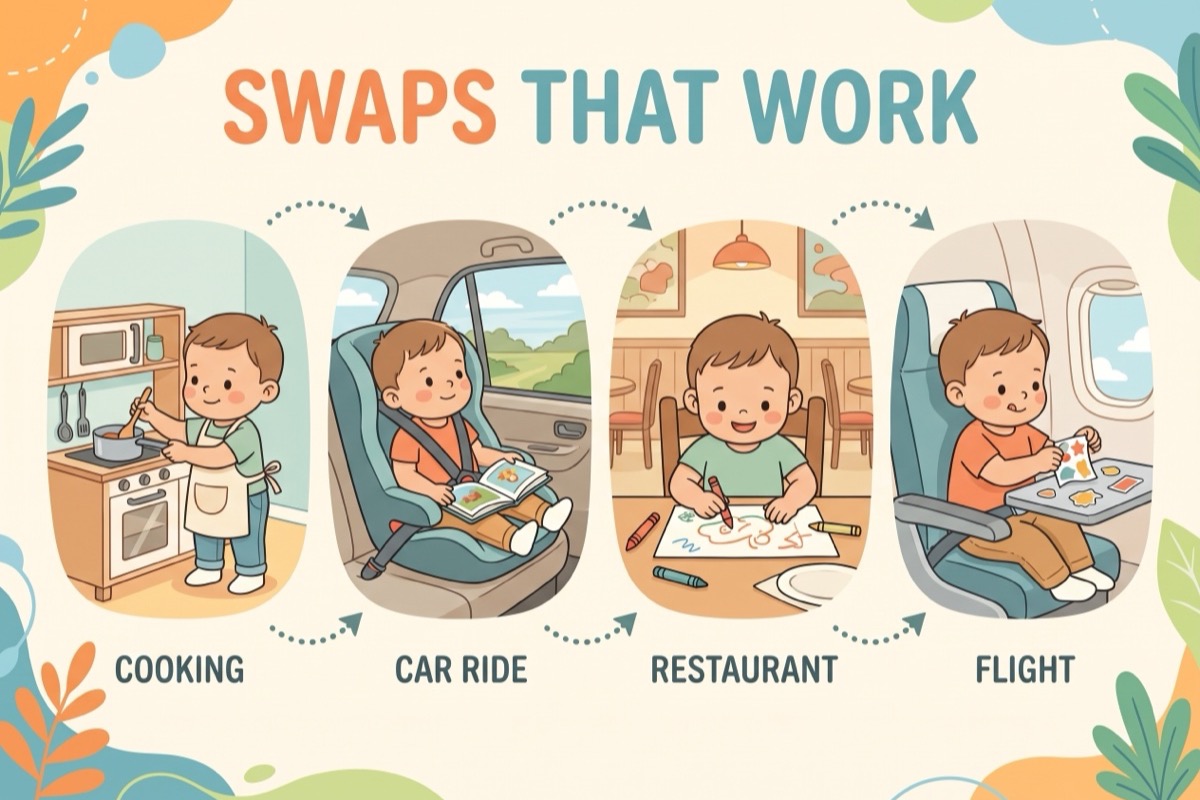
The Moments You Actually Use Screens (and What to Try Instead)
Guidelines are written for an ordinary day. Life keeps serving the other kind. Here are three common ones, with a swap for each and an honest plan B.
Cooking dinner
- Bring the baby into the kitchen. A high chair or play yard within sight, and a running commentary: "Now the onions go in." That is exactly the talk the background-TV study found missing.
- Set up a dinner-only drawer. Pots, wooden spoons and plastic containers in a low drawer that only opens while you cook. Novelty does the work.
- Give a 2-year-old a job. Washing vegetables, tearing lettuce, putting spoons on the table.
- Plan B (ages 2 and up): one chosen episode, counted toward the day's hour.
Flights and long car rides
- Pack a bag of small surprises. A few cheap new toys wrapped in paper, stickers, a board book, snacks in containers that take effort to open.
- Use the aisle and the window. A walk to the back and a look at the clouds are both free.
- Plan B: a few episodes downloaded in advance, chosen by you. For a child under 2, watch together and talk about it. One flight is not a habit.
If a phone is going into small hands for the trip, our iPhone parental controls guide covers what to set up before takeoff.
Restaurants
- Keep a restaurant-only kit. Crayons, a small notepad, two toys that live in the bag and nowhere else.
- Go early and order fast. Then a walk outside while the food is on its way.
- Talk about the room. The cook, the lights, the colors on the plate. A restaurant is full of things to name.
- Plan B: the phone comes out last, after the food arrives, not first thing at sit-down.
And some days you are sick, the baby is sick, or you simply have nothing left. A show on that day is not a verdict on your parenting. The studies above measured habits over months and years, not the Tuesday you had a fever.
What Does Not Work
- "Educational" baby videos. The 2007 survey above found no word-learning benefit, and a deficit for babies 8 to 16 months. In late 2009, Disney offered refunds on Baby Einstein DVDs bought between June 2004 and September 2009. That came after the Campaign for a Commercial-Free Childhood threatened a class-action lawsuit over their educational claims. It was a private legal threat, not the FTC ban it is often retold as.
- Leaving the TV on "because nobody is really watching." Your toddler may not be. You are, a little, and you talk less.
- Making the tablet the main way to calm down. The Nova Scotia study found tablet use and frustration feeding each other. Use it for a show, not as the fire extinguisher.
- Screens as the last step before sleep. Removing them from that final hour improved toddler sleep in a controlled trial.
- Cutting video calls to be strict. The AAP counts them as relationship time. Grandma stays.
- Replacing screens with nothing. A rule without a plan for 5:30 p.m. lasts until 5:30 p.m. The swaps above are the plan.
A Four-Week Plan for Babies and Toddlers
Do not overhaul everything at once. One change a week, in order of how much it pays off for how little effort.
| Week | Focus | What to do | How you know it is working |
|---|---|---|---|
| Week 1 | Background TV | TV off during play and meals. Notice when it goes on out of habit. | You catch yourself narrating more |
| Week 2 | Bedtime | No screens in the hour before bed, for anyone in the child's room. Same wind-down order every night. | Bedtime takes the same shape each night |
| Week 3 | The swap kit | Build the dinner drawer, the restaurant bag and a small travel bag. Try each at least once. | The first reach during dinner prep is a drawer, not a device |
| Week 4 | Good screen time | Under 18 months: set up two regular video calls with family. Ages 2–5: pick shows in advance, watch together, stay within an hour. Write the family rules down. | Screens show up at planned times, and nobody is surprised when they end |
When to Talk to Your Pediatrician
Screen habits are worth mentioning honestly at any well-child visit, background TV included. Bring it up sooner if your toddler's words or attention worry you, or if a screen has become the only thing that settles them. Your pediatrician can help you tell a habit worth adjusting from something that deserves a closer look.
Key Takeaways
- Under 18 months, no screens except video chat. That is AACAP's advice and was the AAP's 2016 guidance. The WHO does not recommend screen time before age 2.
- From 2 to 5, about an hour a day. The WHO says no more than 1 hour for ages 2 to 4, less is better. AACAP allows 3 hours of non-educational screen time on weekend days.
- The AAP no longer sets an hour limit. Its 2026 policy statement points parents to the 5 Cs of Media Use and a Family Media Plan.
- Video calls with family are relationship time. Responsive back-and-forth is what toddlers learn from, on a screen or off it.
- Turn off background TV. It cuts how much parents talk to toddlers, and fixing it costs nothing.
- Screens off an hour before bed. In a 2024 trial, that one change improved toddler sleep.
- Swap, do not just ban. A dinner drawer, a restaurant kit and a travel bag cover most of the moments screens creep in.
Frequently Asked Questions
How much infant screen time is OK?
For babies, very little. The WHO does not recommend screen time for babies under 1 or for 1-year-olds, and AACAP limits screens under 18 months to video chatting with an adult. For ages 2 to 4, the WHO says no more than 1 hour a day, and less is better. AACAP suggests about 1 hour of non-educational screen time on weekdays and 3 on weekend days for ages 2 to 5. The AAP's 2026 policy statement sets no hour limit.
Does video chat count as screen time for babies?
No. The AAP says live video calls with grandparents and other family should not be considered screen time; it calls them relationship time. In a 2014 study, toddlers learned new verbs from a responsive adult on a video call, but not from a recorded video of the same content.
Is background TV bad for babies and toddlers?
It reduces how much parents talk to them. In a study of parents playing with toddlers aged 12 to 36 months, parents spoke fewer words, phrases and new words when a TV was on in the background. Turning it off during play and meals is the simplest change on this list.
Are baby videos educational?
The evidence says no. A 2007 study found infants aged 8 to 16 months understood 6 to 8 fewer words for each daily hour of baby videos, with no effect for older toddlers. Disney later offered refunds on Baby Einstein DVDs after a threatened class-action lawsuit over their educational claims.
Why is my daycare's screen rule stricter than the guidelines for home?
Your daycare may be following the CDC's standards for licensed early care and education. They say no media viewing for children under 2, and no more than 30 minutes a week for children 2 and older. That time is limited to educational or physical-activity content and never during meals. Those standards are for child-care settings, not home.
My toddler already watches a lot. Is it too late?
No. The research describes modest associations with habits kept up over years, and habits can change. Start with the two easiest wins: background TV off during play, and no screens in the hour before bed. A 2024 trial found that the bedtime change alone improved toddler sleep.
Related Reading
- Recommended Screen Time by Age: What the Guidelines Say (2026)
- Screen Addiction in Kids: 9 Signs and How to Break the Loop (2026)
- What Age Should a Child Get a Phone? A Readiness Checklist (2026)
- Smartphone Free Childhood: What Towns and Countries Actually Did (2026)
- Parental Controls on iPhone: A 15-Minute Setup for Kids (2026)
- How to Check Screen Time on Android and Limit It for Kids (2026)
Turn your screen rules into a daily checklist your kids can see
Write the rules once (TV off during play, no screens before bed, one chosen show) and turn them into a chart for the fridge. Printable, free, no signup.
Make a free screen rules chart
