Smartphone Free Childhood: What Towns and Countries Actually Did (2026)
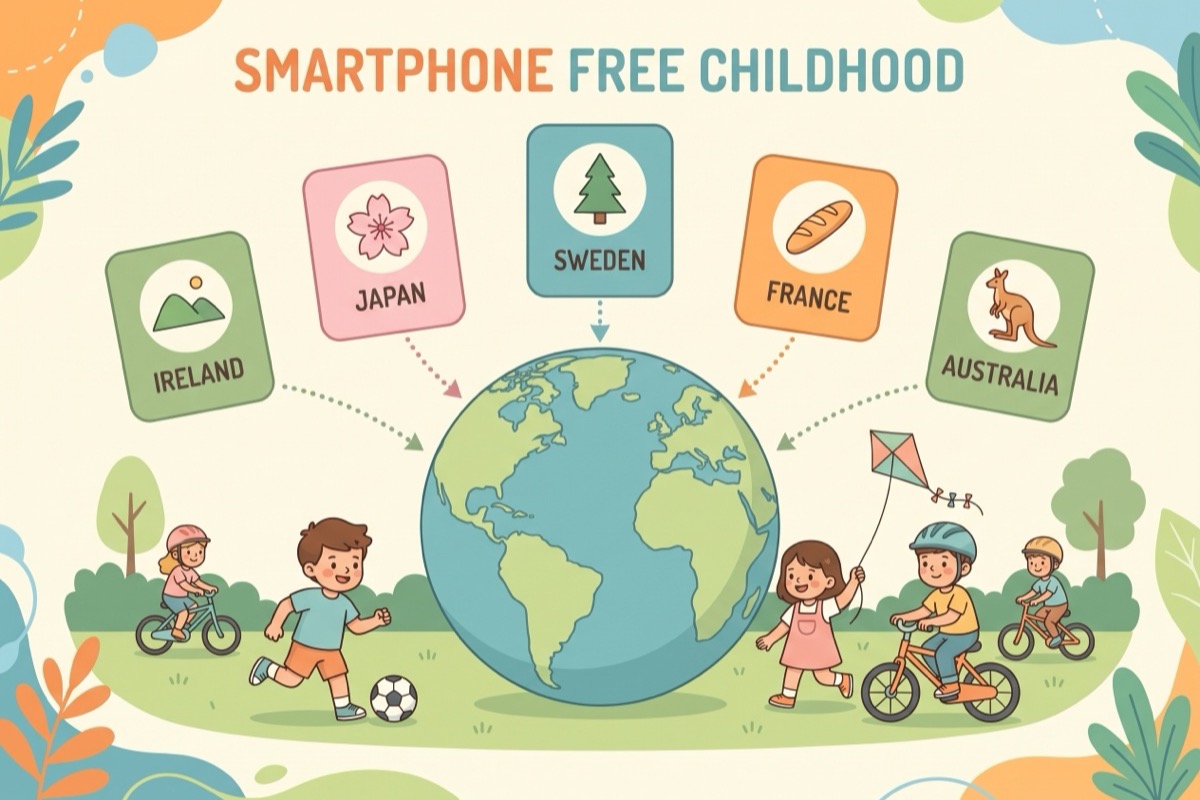
Somewhere in your child's class a group chat is asking the question you are asking: does everyone really have a phone already? Smartphone Free Childhood is a UK parents' movement launched in February 2024. Its Parent Pact asks families to wait until 14 for a first smartphone and 16 for social media. The same idea shows up elsewhere as town pacts, school phone bans, national screen-time advice and one age-16 social media law. The good news: you are not the only family saying "not yet." The less good news: most of these experiments are too new to show how they turned out.
This is the tour: Greystones in Ireland, Toyoake in Japan, Sweden, France, the UK and Australia, plus the US pledge Wait Until 8th. For each, the rule, whether it is binding, and what a US family can borrow. Then the practical part: how to build a phone free childhood pact with the other parents in your class. If you are still settling on the age itself, start with our readiness checklist for a first phone.
What the Research Actually Says
Most of this movement traces back to one book. Jonathan Haidt's The Anxious Generation came out from Penguin Press on March 26, 2024. Its subtitle states the thesis plainly: How the Great Rewiring of Childhood Is Causing an Epidemic of Mental Illness. The book lays out US data showing that, starting around 2010, teens began spending less time with friends and getting less sleep. Over the same years, anxiety and depression diagnoses and self-harm went up. The shifts hit girls harder than boys, and they did not show up in adults over 30.
Haidt is sometimes described as wanting phones banned outright. As the book is usually summarized, his norms are more specific: no smartphone before high school, no social media before 16, phone-free schools, and far more unsupervised, independent play. He points to Wait Until 8th as an existing US example; he did not start it.
Now the American reality check. A 2025 Pew Research Center survey of 3,054 US parents of children 12 and under found that 68% think kids should generally be at least 12 before owning a smartphone. In the same survey, about 60% of 11- and 12-year-olds and 29% of 8- to 10-year-olds already owned one. Common Sense Media puts the average age of a US child's first phone at about 11. Its own experts recommend waiting until 13.
Every pact in this article is an attempt to close that gap between belief and practice. Nobody wants their kid to be the only sixth grader without a phone, so each family waits for another to go first. A pact is an agreement to go first together. One caution: none of the measures in Ireland, Japan, Sweden or Australia has measured results yet. If someone says a town "proved" that phone-free childhood works, the honest reply is that it is too early to know.
What Other Countries Do About Kids and Phones, in One Table
Every example in this article, side by side. Watch the third column: a lot of what gets shared online as a "ban" is voluntary, advisory or limited to school hours.
| Where and when | What it says | Binding? |
|---|---|---|
| Greystones, Ireland (May 2023) | No smartphone until secondary school; apps such as Snapchat, Instagram, WhatsApp, TikTok and Discord are the real target | Voluntary parent code across all eight primary schools |
| Ireland, national (June 2025) | Circular 0044/2025: no personal phone use or access for the whole school day | Mandatory for every recognised primary school |
| Toyoake, Japan (October 2025) | At most two hours a day of recreational device use outside work and school; devices off after 9pm for elementary kids, 10pm for junior high and older | Advisory; no fines or penalties |
| Sweden (2024) | Public Health Agency's screen-time recommendations: none under 2, at most about 1 hour at 2–5 and 2 hours at 6–12 | Public health advice; no phone-age law |
| France, schools (2018, 2025) | Phone use banned in school since 2018; phones handed in for the whole day at collège (middle school) | 2018 law; the hand-in rule comes from a 2025 ministerial circular |
| France, expert commission (April 2024) | No phone before 11, a phone without internet from 11 to 13, no social media from 13 to 15 | Recommendations in a report to the president |
| UK, Smartphone Free Childhood (2024) | Parent Pact: no smartphone before 14, no social media before 16 | Voluntary |
| England, schools (2024, 2026) | Department for Education guidance on keeping phones out of the school day | Statutory; schools must follow it from September 1, 2026 |
| Australia (in force December 10, 2025) | Minimum age of 16 to hold an account on named social media platforms | Law; penalties fall on platforms, not families |
| US, Wait Until 8th (2017) | No smartphone until at least the end of 8th grade; a basic phone is fine | Voluntary; activates at 10 families per grade and school |
The pattern: binding rules cover school hours or the platforms. Home, after 3pm, is still up to parents, alone or together.
Ireland: A Parents' Pact, Then a National School Rule
In May 2023, the parents' associations of all eight primary schools in Greystones, County Wicklow, backed a voluntary "no smartphone" code. The ask was to hold off on a smartphone until a child starts secondary school. The Irish Times report is worth reading for the fine print. The code named apps, including Snapchat, Instagram, WhatsApp, TikTok and Discord, as the real target. School principals said they were not opposed to a basic phone for calls and texts.
Some headlines called Greystones "the town that banned smartphones." It banned nothing. It was a pact among parents, aimed at the one thing a single family cannot do alone: making "not yet" the normal answer for a whole year group.
On June 12, 2025, Ireland's Department of Education and Youth published Circular 0044/2025. It requires every recognised primary school to have a policy banning pupils' use of, and access to, personal phones for the entire school day. It is binding, but it stops at the school gate. Evenings, weekends and whether a 10-year-old gets a smartphone at all are still decided at home. The national rule is too new to evaluate.
Japan: Toyoake's Two-Hour Guideline
Toyoake, a city of about 68,000 in Aichi Prefecture, went a different way. On September 22, 2025, its city assembly voted 12 to 7 for an ordinance on screen time. It recommends that all residents keep recreational use of smartphones, game consoles and other devices to two hours a day, not counting work or school. It asks elementary-school children to stop using devices after 9pm, and junior-high students and older to stop after 10pm. It took effect on October 1, 2025.
The key word is recommends. There are no fines and no penalties, and coverage of the ordinance describes it as the first of its kind in Japan. Mayor Masafumi Kouki said the two-hour figure came from the Ministry of Health, Labour and Welfare's sleep guidelines and from the city's own average weekday device use. It applies to adults too, which is a nice touch for any parent who has checked their own phone during a lecture about screens. It is too new to evaluate.
Sweden and France: Advice by Age, Rules at School
Sweden: screen-time advice, not a phone law
Sweden has no law setting an age for a first phone. What it has is the Public Health Agency's 2024 screen-time recommendations, from Folkhälsomyndigheten (the English PDF). They advise no screens at all under 2 and no more than about one hour a day of leisure screen time from 2 to 5. From 6 to 12, the advice is no more than about two hours a day. Parents of 6- to 12-year-olds are told to "follow the age limits" that social media and game platforms set. For every child and teen, phones and tablets stay out of the bedroom overnight, and screens go off 30 to 60 minutes before bed.
This is public health advice, and it is too new to evaluate. What it offers you is two sleep rules you could adopt tonight. Our guide to recommended screen time by age puts the hour limits in context.
France: a school phone ban, then a stricter one
France has banned the use of mobile phones and other electronic communication devices in nursery schools, elementary schools and collèges during the school day since 2018. That law meant phones off and put away. From the start of the 2024 school year, about 180 collèges piloted a stricter "pause numérique," covering roughly 50,000 students aged 11 to 15. Phones were physically handed in for the whole day.
A ministerial circular published July 10, 2025, extended that pause to all public collèges from the 2025 school year. Full rollout is required by the 2026 school year at the latest. It is a circular, not a new law. It covers smartphones, tablets and connected watches, and a breach can now lead to confiscation or a disciplinary sanction.
France: the expert commission's age thresholds
Separately, a 10-member expert commission co-chaired by neurologist Servane Mouton and addiction psychiatrist Amine Benyamina gave President Emmanuel Macron a 125-page report on April 30, 2024 (summary in French). Its thresholds are the most detailed of any in this article:
- Before 3: no screens. Before 6, only occasional, adult-supervised, high-quality content.
- Before 11: no personal phone at all.
- 11 to 13: a phone without internet.
- 13 to 15: an internet phone without social media.
- After 15: "ethical" networks such as Bluesky or Mastodon over mainstream platforms.
The report also proposed a 10am start for collège and lycée and an hour of daily exercise for under-10s instead of 30 minutes, citing screen-linked sleep loss and inactivity. These are recommendations, not rules. Their value for you is the staging: a first phone is not one decision, it is three or four.
The UK and Australia: A Parent Movement and an Age-16 Law
UK: Smartphone Free Childhood and the Parent Pact
The name on this article comes from the UK. Smartphone Free Childhood was launched in February 2024 by two parents, Daisy Greenwell and Joe Ryrie, after a conversation at a school gate. By Wikipedia's count it has grassroots chapters in 39 countries. Its Parent Pact asks families to delay a first smartphone to 14 and social media to 16. When we checked in September 2026, the group's own site reported over 190,000 families signed, representing more than 55% of UK schools. That count is self-reported, so read it as a snapshot.
England's schools moved too. The Department for Education published non-statutory guidance, "Mobile phones in schools," on February 19, 2024. It explained how schools can prohibit phone use for the entire school day, breaks and lunch included. A revised version became statutory on June 29, 2026, and schools must follow it from September 1, 2026. As of this month, it is no longer just advice.
Australia: the under-16 social media law
Australia went after platforms instead of phones. The Online Safety Amendment (Social Media Minimum Age) Act became law in December 2024, and the age rule took effect on December 10, 2025. It sets a minimum age of 16 to hold an account on the social media platforms the law covers. Penalties fall on the platforms, not on children or parents. It has been in force for less than a year, so treat any claim that it "worked" or "failed" with care. For the app-by-app rules in the US, see our guide to social media age limits.
How to Build a Smartphone Free Childhood Pact in Your Class
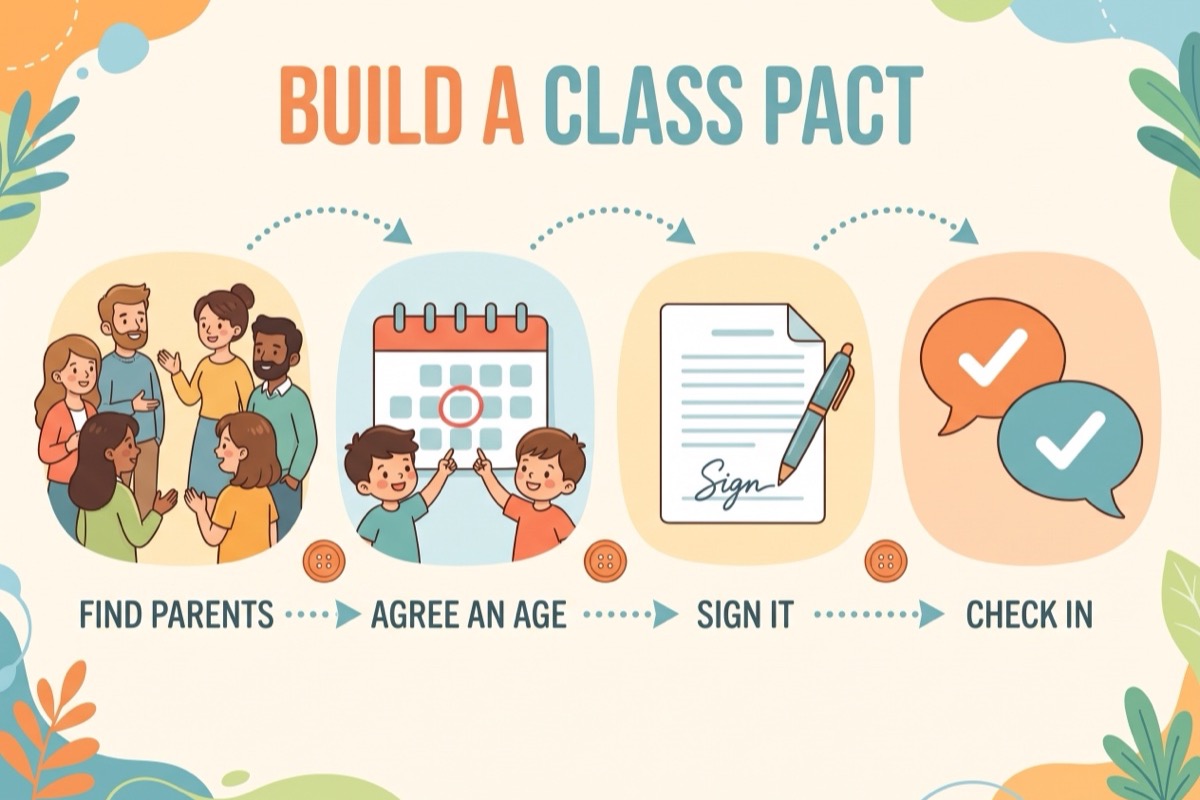
This part you can start this week. It borrows from Greystones, Wait Until 8th and the Parent Pact, at the scale that matters most: one class or one grade.
- Start with two or three parents, not the whole class. Smartphone Free Childhood began with one conversation at a school gate.
- Write down exactly what you are delaying. One sentence. "No smartphone until the end of 8th grade" (Wait Until 8th). "No smartphone before 14, no social media before 16" (the Parent Pact). "No smartphone until secondary school," with named apps as the target (Greystones). A vague pact is hard to hold when the first phone shows up as a birthday present.
- Say what kids can have. Greystones principals had no objection to a basic phone for calls and texts, and Wait Until 8th explicitly allows one. Naming the allowed option answers "but how will I reach them" before anyone asks.
- Set an activation number. Wait Until 8th activates only once 10 families in the same grade and school have signed; then signers can see each other. Borrow that. Nobody is committed until enough families are.
- Keep it voluntary, and say so. Greystones was a code, not a rule. No pressure at pickup.
- Leave the school day to the school. In Ireland, France and England, school-hours rules came from national governments. Your pact covers the hours the school does not.
- Plan what fills the time. Haidt's fourth norm is more unsupervised, independent play. A pact that only takes something away feels like a punishment to a kid. Add something: a standing weekend meetup, a walking group to school, a park afternoon.
- Set a check-in date. Revisit the pact once a school year. The age your class picked in 4th grade may need a fresh conversation by 7th.
When you tell your own child, keep it about the family and the class, not about them. "We decided to wait, and so did a lot of families in your class" goes down easier than a lecture on anxiety statistics. It also happens to be true, which helps.
What Does Not Work
Most of the mistakes come from treating a pact like a law, or a law like a pact.
- Calling it a ban. Ban language turns neighbors into rule-breakers. A pact invites; a ban accuses.
- Waiting for everyone else. The Pew numbers show where that leads: most parents want to wait until at least 12, and most 11- and 12-year-olds already have a smartphone.
- Expecting a law to cover the evening shift. Australia's penalties land on platforms, not families. Toyoake has no penalties at all. Neither decides where your 11-year-old's phone sleeps.
- Treating a school rule as a home rule. A school-day ban covers school hours. It says nothing about the bus ride, the sleepover or 10pm.
- Promising results. "It worked in Ireland" is not something anyone can say yet. Pitch the pact on its own logic: going first together.
- Using it to shame. Families who do not sign have their own reasons. A pact that splits the class has lost its point.
If your question is no longer when to get a phone but how to manage one that has taken over, start with our guide to screen addiction in kids.
A Four-Week Plan to Start a Class Pact
One month takes you from "someone should do something" to a signed pact.
| Week | Goal | What to do |
|---|---|---|
| Week 1 | Find your core group | Talk to two or three parents in the same grade. Agree on one sentence describing what you are delaying and until when. |
| Week 2 | Write the pact | One page: what is delayed, until what age or grade, what is allowed (a basic phone), and the number of families needed before it activates. |
| Week 3 | Share it | Bring it to a parent meeting or the class chat. Say clearly that it is voluntary. Answer questions; keep no list of who declines. |
| Week 4 | Activate and tell the kids | Once enough families sign, share names among the signers. Each family tells its kids in the same words. Put a check-in date on the calendar for next school year. |
Key Takeaways
- A smartphone free childhood is something families build together. Every pact in this article runs on numbers, not willpower.
- Greystones was a voluntary parent code, not a ban. Ireland's binding rule, from 2025, covers the school day in primary schools.
- Advice and laws leave the evenings to you. Toyoake's two hours carry no penalties; Australia's age-16 law penalizes platforms, not families.
- France's expert commission offers the clearest staging. No phone before 11, no internet on the phone until 13, no social media until 15.
- The newest measures have no measured results yet. Ireland's national rule, Toyoake's ordinance, Sweden's advice and Australia's law all date from 2024 or 2025.
- To start a pact: two or three parents, one sentence, a basic-phone option, an activation number, a check-in date.
Frequently Asked Questions
What is a smartphone free childhood?
It is two things. Smartphone Free Childhood is a UK movement launched in February 2024 by parents Daisy Greenwell and Joe Ryrie. Its Parent Pact asks families to delay a first smartphone to 14 and social media to 16. It is also the general idea of families agreeing together to delay smartphones and social media.
Which countries have phone bans in schools?
France has banned phone use in nursery, elementary and middle schools during the school day since 2018. A July 2025 ministerial circular requires phones to be handed in for the whole day at public middle schools. Ireland's Circular 0044/2025 bans phone use and access for the school day in every recognised primary school. England's school phone guidance is statutory, and schools must follow it from September 1, 2026.
What is Wait Until 8th?
A US pledge founded in 2017 by Brooke Shannon in Austin, Texas. Parents promise not to give their child a smartphone until at least the end of 8th grade. The pledge activates, making signers visible to each other, only once 10 families in the same grade and school have signed. A basic call-and-text phone is still allowed.
Does Sweden have a law on when kids can get a phone?
No. Sweden has no law setting an age for a first phone. It has the Public Health Agency's 2024 screen-time recommendations. They advise no screens under 2, at most about one hour a day from 2 to 5 and about two hours from 6 to 12. They also advise keeping phones out of the bedroom overnight.
Did the Greystones smartphone pact work?
There is no measured answer yet. Greystones was a voluntary code backed by the parents' associations of all eight primary schools in May 2023. Its aim was to make "not yet" the normal answer for a whole year group. Ireland's national school-day phone rule, which came in June 2025, is too new to evaluate.
What age do experts recommend for a first smartphone?
There is no single answer. France's 2024 expert commission recommended no personal phone before 11, a phone without internet from 11 to 13, and no social media before 15. The UK Parent Pact says 14, Wait Until 8th says the end of 8th grade, and Common Sense Media's experts say 13.
Related Reading
- What Age Should a Child Get a Phone? A Readiness Checklist (2026)
- Social Media Age Limits: The Main Apps, Laws and Countries (2026)
- Recommended Screen Time by Age: What the Guidelines Say (2026)
- Screen Addiction in Kids: 9 Signs and How to Break the Loop (2026)
- Parental Controls on iPhone: A 15-Minute Setup for Kids (2026)
- How to Check Screen Time on Android and Limit It for Kids (2026)
Turn your screen rules into a checklist your kids can see
A pact is a promise between parents. A chart is how kids see it. Our free maker turns your screen rules into a daily checklist for the fridge. Printable, no signup required.
Make a free screen rules chart
